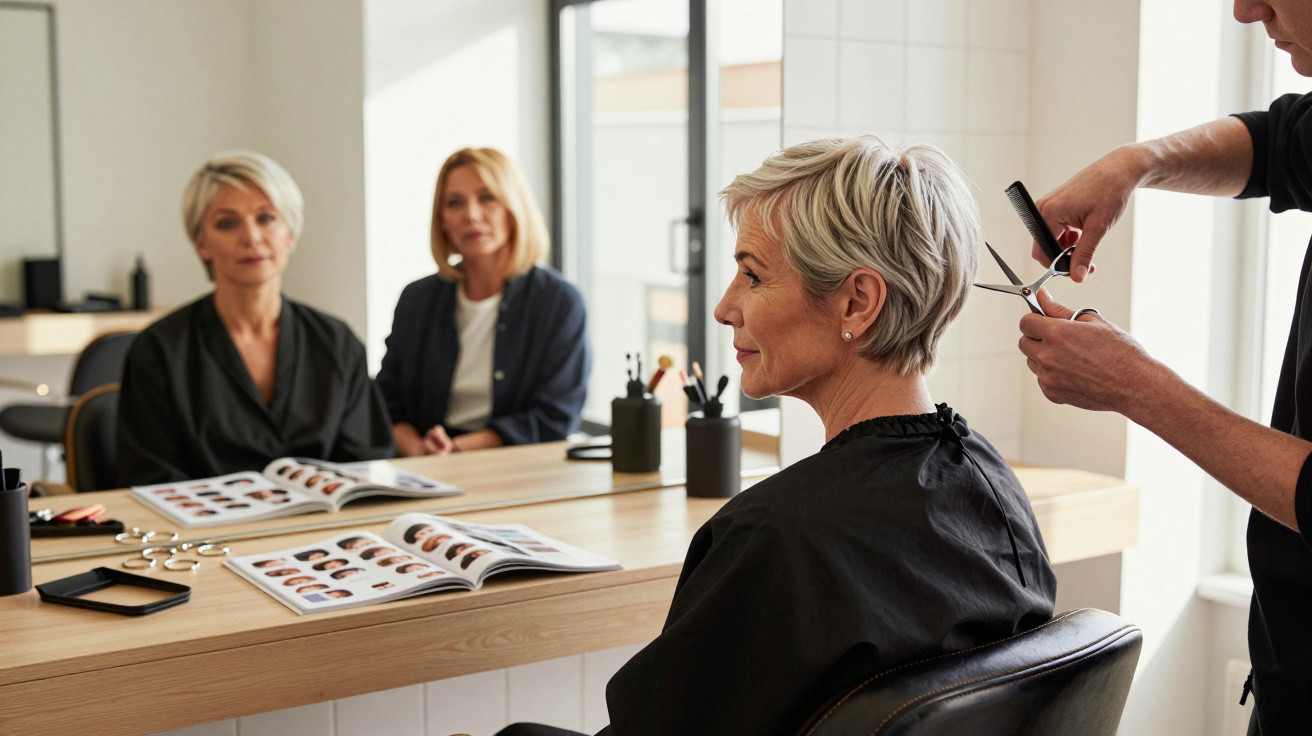
The hairdryer is still whirring through the salon when she asks, clearly enough for three nearby chairs to hear: “Am I too old for this cut?” At 67, dressed in a navy cashmere jumper, she grips her glasses as though they offer protection. Her phone, resting on the trolley beside her, displays a razor-short pixie with chopped-up texture and an unapologetic fringe.
Her stylist gives the knowing smile of someone who has answered this question countless times. A woman two seats away arches an eyebrow. The unspoken judgements are almost tangible: bold, sweet, desperate, age inappropriate, goals.
For women over 60 with fine hair, a short hairstyle can turn an ordinary salon visit into a public vote.
The amusing part is that stylists privately adore these “controversial” cuts.
Critics… not so much.
The pixie that splits the waiting room
Ask an experienced stylist which short style provokes the strongest reactions and the answer will usually be the modern pixie. On fine hair after 60, responses tend to be either “You look ten years younger” or “What have you done?” There is seldom anything in between.
The divisive version is not the tidy, softly tucked-under pixie of the 1990s. It is closely cropped at the nape, slightly undone at the crown and finished with bangs that hover around the eyebrows. It leaves neck lines, hearing aids and a softened jawline on display.
It is the sort of cut that never seeks approval.
And that is precisely why stylists stand behind it.
A London stylist I spoke to recalled her most polarising client: Helen, a 72-year-old retired teacher. Helen arrived with shoulder-length, flyaway hair that she called “beige and invisible.” Her grand-daughter had shown her an image of a silver pixie with a jagged fringe. “She said, ‘Gran, you’d look hot with this,’” the stylist laughed.
They went ahead with it, cutting Helen’s hair shorter than she had ever worn it. The stylist added texture through the top and kept the fringe chunky and rebellious. Once Helen shared the result on Facebook, opinions appeared immediately. Some friends commented, “Wow, you look incredible!” Others quietly said offline that she was “trying too hard” and “too old for that rocker look.”
Helen made her next booking before walking out of the salon.
The critics weren’t paying her bill.
Why can a few centimetres of hair stir up such a response? Short hairstyles on older women violate two unspoken expectations at once: women are meant to fade into the background, and they are certainly not expected to look edgy while doing so. A cropped cut, particularly on fine hair, directs attention towards every feature we have been taught to conceal.
Fine hair makes the contrast even more pronounced. Worn long, it may appear limp or sparse. Cut short, it can suddenly look deliberate and crisp. That move from “I can’t grow it” to “I chose this” can unsettle those who still equate femininity with length.
The plain truth is that a powerful pixie on a 65-year-old clearly says, “I am not decorating your idea of aging gracefully.”
That is what people are truly reacting to.
The “age-inappropriate” bob - and why stylists cut it regardless
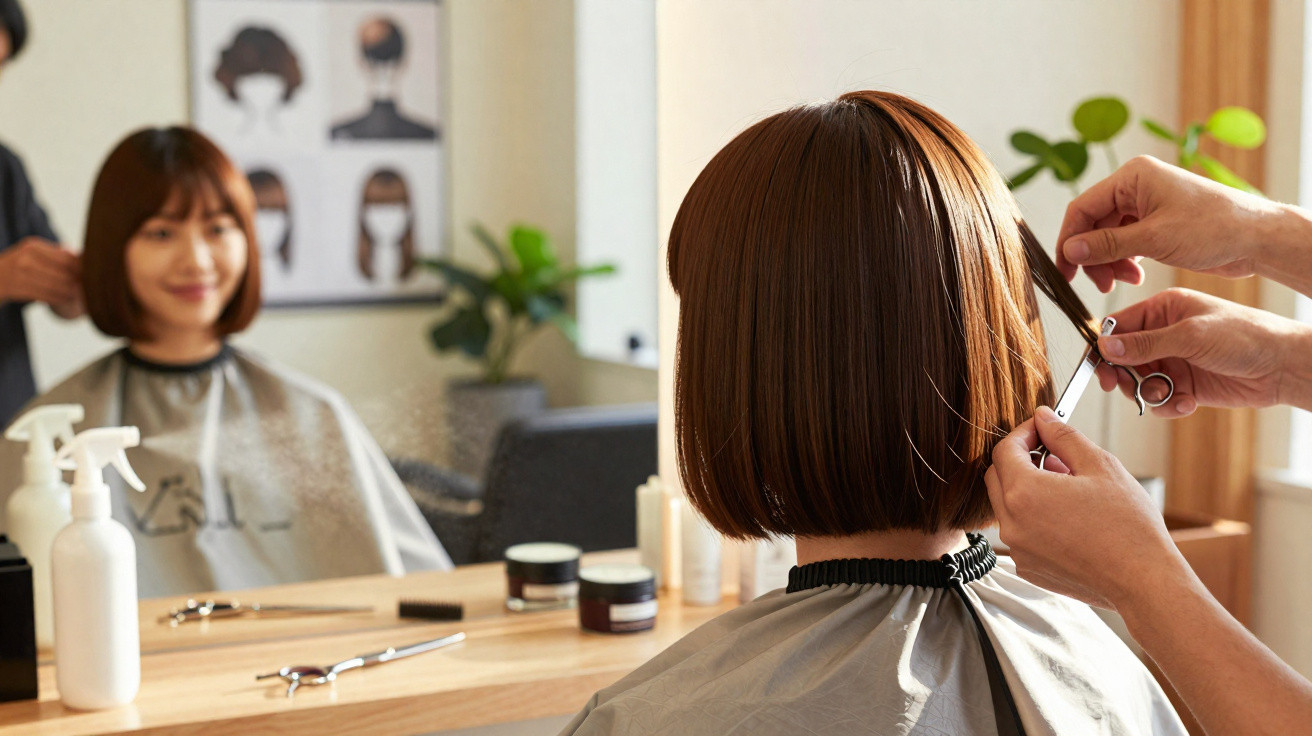
The next most debated option is the jaw-skimming French bob, with blunt ends and a proper fringe. For fine hair over 60, it sits somewhere between Parisian chic and “trying to look like your granddaughter.” Stylists favour it because it instantly gives the impression of density: blunt edges make thin hair seem fuller, while the shorter shape creates lift around the face.
The details are what make it contentious. There may be a straight fringe grazing the eyelashes, a bob that exposes the nape and minimal layering, leaving a strong, defined outline. On a 30-year-old, it reads as cool and editorial. On a 68-year-old, people begin calling it “too harsh” or reaching for that familiar coded phrase: “brave choice.”
Yet colourists and cutters continue to recommend it in private.
They understand what can happen once the mirror turns around.
Consider Maria, 64, who came into a suburban salon wearing a thick headband and giving a nervous laugh. “I’ve had the same cut since the kids were in high school,” she admitted, indicating a long, wispy bob that she constantly had to pin back. Her fine hair slipped over her shoulders and would not maintain volume.
Her stylist proposed a French bob ending directly at the jaw, paired with a fuller fringe to disguise thinning at the hairline. Maria’s immediate reaction was, “Isn’t that a bit young?” In reply, the stylist showed her before-and-after photographs of women of Maria’s age and older. The same wrinkles. The same fine hair. The same uncertain smile becoming something different.
They took their time. The length came off first, followed by the fringe, which was cut dry so they could stop wherever Maria felt comfortable. When she left the salon, she still looked like herself - only more defined, lighter and, somehow…finished.
Her daughter’s later text captured it perfectly: “Mum, you look like yourself again, not like someone’s idea of a ‘senior haircut.’”
Those who object to these short bobs usually return to one concern: being judged for failing to “act your age.” A bob with a genuine fringe can seem youthful because it brings to mind art students and French actresses, rather than women comparing cataract surgeons. That is the trap.
Technically, fine hair often performs better at this kind of length. Weight concentrated at the ends produces a fuller-looking line. A jaw-length shape visually raises the cheeks. A fringe can soften a lined forehead without relying on heavy make-up. The elements labelled “age-inappropriate” are frequently the most flattering features on older faces.
Let’s be honest: nobody really does this every single day, but with the right cut, you don’t need a 30-minute blow-dry ritual to look pulled together.
The controversy exists more in other people’s expectations than in the mirror.
Making a “controversial” short cut work with fine hair over 60
If you are considering a short, divisive style, think in millimetres rather than dramatic leaps. There is no need to move from shoulder length to a buzz cut in one appointment. Ask for a “test crop”: have the back and sides shortened first, while retaining extra length over the top and around the face.
For fine hair, texture combined with structure is the effective formula. In practice, that means a clear overall silhouette - either a pixie or bob - alongside small, feathered details worked through the crown to encourage volume. Used gently, scissors or a razor can add movement without shredding the hair. For styling, a pea-sized amount of lightweight mousse or volumising spray at the roots will do.
The goal isn’t to look younger at all costs; it’s to look like you now, on purpose.
There is a major difference, and you notice it every morning in front of the mirror.
One of the quickest routes to disliking a short cut is copying another person’s hair without adapting it to your own circumstances. The French bob saved on Pinterest may belong to someone with three times your density and no cowlicks at all. Your everyday life counts too: arthritis in your hands, product sensitivities and how frequently you genuinely want to style your hair.
Speak to your stylist as you would a tailor. Which features do you want to highlight? Which would you prefer to skim over? Are you happy for your ears to be entirely visible? Should your fringe sit clear of your glasses? There is no prize for enduring a style that requires daily round-brush work when you live in ponytail territory.
If a style requires a complete toolkit and several products each morning, it is probably unsuitable for fine hair over 60.
A controversial cut must still be practical to live with.
A veteran stylist in New York told me, “The women who really glow in their sixties are the ones who stop asking, ‘Is this appropriate for my age?’ and start asking, ‘Does this feel like me now?’ The ‘age-inappropriate’ label usually comes from people who are scared of their own reflection changing.”
- Request “soft edges”, rather than “more layers”
Excessive layering may leave fine hair looking stringy. Soft edges at the ears and neckline make the style feel current without losing fullness. - Bring photographs of women your own age, not your daughter’s
Images are useful, but look for comparable skin texture, hair type and even overall feel. A realistic reference photo is more likely to result in a cut you will genuinely wear. - Set your “non-negotiables” before the scissors come out
Perhaps you do not want your ears visible, or you need coverage over a scar on your neck. State this clearly. A talented stylist can still produce an edgy shape within firm boundaries. - Plan for growing it out
Controversial cuts require a plan. Ask how the style will look in two months and when you will need small maintenance trims to avoid the “mushroom” stage. - Anticipate comments, and prepare a one-line response
From “You’re brave” to “I liked it longer”, people will offer opinions. A composed, rehearsed reply - “I love how easy it is” - ends the discussion quickly.
What “too young” cuts reveal about ageing, fine hair and choice
Spend enough time in any salon and a pattern becomes clear: the strongest views on what women over 60 “should” do with their hair rarely belong to the women in the styling chairs. They tend to come from partners, adult children and acquaintances at book club. Meanwhile, clients with fine hair repeatedly lower their voices to say the same thing: “I just want to feel like myself again.”
Short, polarising hairstyles - choppy pixies, jaw-length bobs with real fringes and bold crops revealing the neck - bring that understated wish into full view. They attract praise and criticism in equal measure because they are visible decisions in a culture that would rather older women blend into beige.
What if the actual controversy is not the length, but the permission? Fine hair over 60 can certainly support a daring cut when the technique respects both its texture and your daily routine. The surprise comes from rejecting the gentle, safe, “age appropriate” template.
Perhaps you will try a micro-fringe and dislike it. Perhaps your first pixie will feel overly exposed until the sides are adjusted. That is part of the process. Hair grows. Identity changes. This is not your final opportunity to get it right.
The next time somebody asks, “Isn’t that a bit young for you?” you may hear another question beneath it: “What would happen if I let myself change that much?”
And that is a conversation worth having.
| Key point | Detail | Value for the reader |
|---|---|---|
| Structured short cuts suit fine hair | Pixies and blunt bobs build density and lift, particularly around the crown and jawline | Helps you select cuts that work with, rather than against, thinning or delicate strands |
| “Age-inappropriate” is usually code for “visible” | Bold silhouettes and fringes challenge expectations of how women over 60 should look | Gives you wording to identify and dismiss biased criticism of your choices |
| Personal comfort beats trends | Gradual changes, clear non-negotiables and realistic styling routines | Allows you to experiment with confidence rather than ending up with a cut you secretly resent |




Comments
No comments yet. Be the first to comment!
Leave a Comment