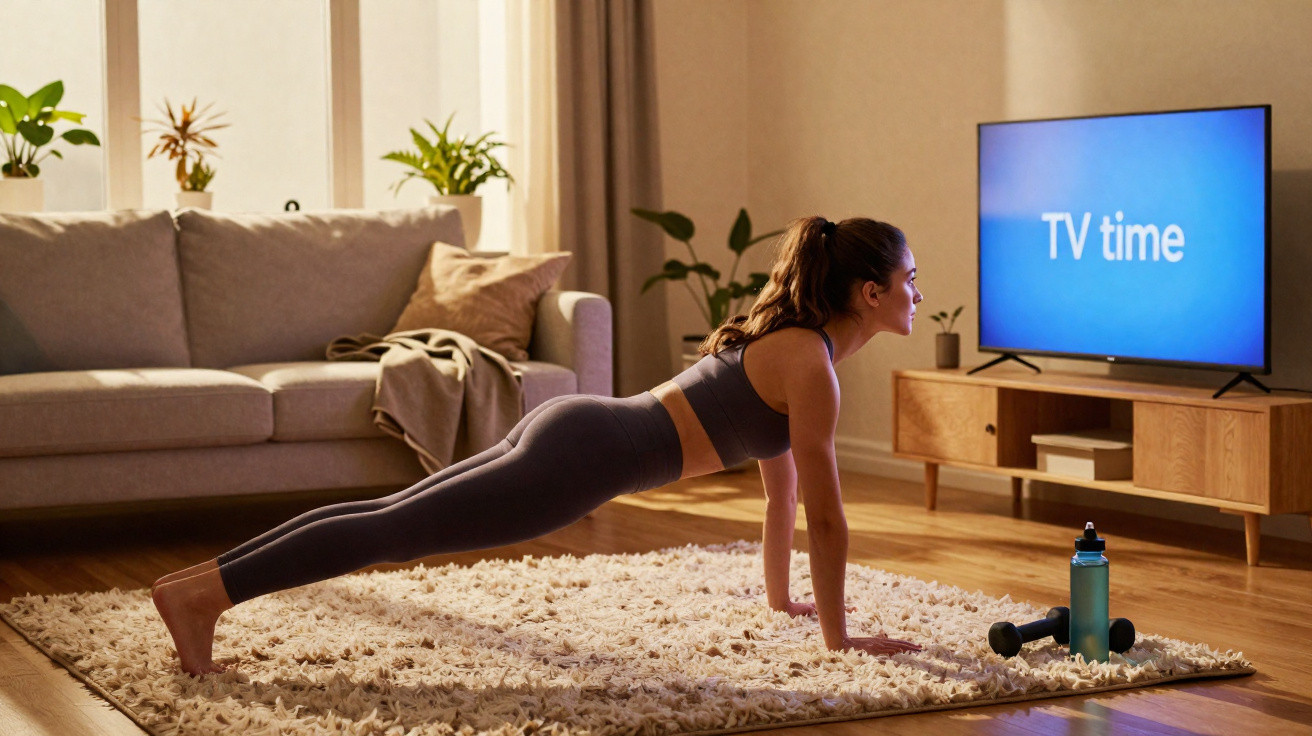
Your living room could be the most convenient fitness space you have.
After lengthy working days and evenings spent binge-watching series, finding the drive to go to the gym may seem impractical. But a handful of straightforward movements, performed while you watch television, can gradually change your midsection, strengthen your back and support your pelvic floor.
Why a sedentary lifestyle encourages belly fat
From your late thirties and into your forties, abdominal fat often becomes harder to shift. Changes in hormones, stress and a slower metabolism can all contribute. Spending hours seated - whether at a desk, behind the wheel or on the sofa - makes it easier for fat to gather around the waist, particularly below the navel.
This is about more than appearance. Visceral fat, the deeper fat that surrounds the organs, is linked with a greater risk of type 2 diabetes, cardiovascular disease and metabolic problems. People whose weight stays fairly stable can still develop a “soft” layer of fat around their middle.
Slow, controlled core exercises help wake up deep abdominal muscles that support the spine and contribute to a flatter, more stable stomach.
Meanwhile, the pelvic floor - a hammock-like group of muscles at the bottom of the pelvis - may lose strength through ageing, pregnancy, constipation or extended periods of sitting. This can influence bladder control, posture and the way your abdomen both feels and appears.
Why television time can work for your abs
Many people insist they “have no time” to exercise, while spending two to four hours in front of a screen most evenings. Dedicating just a few of those minutes to movement can make a difference without requiring a major lifestyle change.
Core exercises suited to watching TV have three things in common: they are quiet, rely more on concentration than brute strength, and need very little room. That makes them easy to fit into an episode of a series or a film.
The goal is not to sweat through a hardcore workout, but to transform passive time into gentle, consistent training for your midsection.
Rather than doing countless crunches, experts prefer movements that activate the deeper core - particularly the transverse abdominis, which works like a built-in corset. These muscles support the lumbar spine, stabilise the pelvis and draw the stomach inwards.
4 simple exercises for your abs in front of the TV
The following four exercises work the waist, lower abs and pelvic floor. No equipment is needed, and they can be modified for nearly any ability level.
1. Side plank: the quiet waist sculptor
The side plank is an effective exercise for the obliques, the muscles along the sides of the waist, as well as the deep core.
- Lie on one side with your forearm on the floor and your elbow directly beneath the shoulder.
- Place your legs and feet one on top of the other, keeping your body aligned.
- Raise your hips, creating a diagonal line from your shoulders down to your ankles.
- Tighten your abs and glutes, lengthen your neck and breathe evenly.
Maintain the position for 10–20 seconds, take a rest, then complete two or three repetitions on each side. If it is too demanding, bend your knees and support yourself through them rather than your feet.
Short, steady side planks strengthen the waist, improve posture and help your jeans close more comfortably.
2. Seated TV abs: the lazy-night favourite
You can perform this movement directly on the sofa, making it ideal for evenings when getting down onto the floor is out of the question.
- Sit near the front edge of the sofa with a straight back and relaxed shoulders.
- Keep both feet flat on the floor, about hip-width apart.
- Exhale, then gently pull your navel in towards your spine.
- Raise one knee by a few centimetres while keeping your torso tall.
- Slowly lower it before repeating with the opposite knee.
Your upper body should remain upright throughout; do not curl forwards as you would in a crunch. Do 10–15 lifts on each leg for two rounds. For a harder version, place a resistance band around your feet or lean slightly backwards while maintaining a straight back.
3. Scissor legs: targeting the lower belly
Perform this exercise on the floor, preferably using a mat or a thick blanket.
- Lie on your back with your arms by your sides and palms facing down.
- Brace your core and lightly press your lower back into the floor.
- Lift both legs a few centimetres above the ground.
- Bring one leg up to roughly 45 degrees while keeping the other low.
- Alternate the legs in a controlled scissor-like action.
Move at a slow pace. Should your lower back begin to arch or feel sore, raise the legs slightly higher or bend your knees. Complete 15–20 switches, rest, then repeat once or twice.
4. Flutter kicks: small moves, big burn
Flutter kicks are similar in position, but involve shorter and quicker movements that test muscular endurance.
- Remain on your back, with your lower back gently pressed into the floor.
- Hold your legs just above the floor.
- Perform small, quick upward and downward kicks with your legs straight or softly bent.
- Continue breathing while keeping your stomach pulled in.
Begin with 10–15 seconds, rest, then work towards two or three rounds. You should notice warmth in the lower abs rather than sharp pain in your back or hips.
How to build these exercises into your TV routine
Regularity matters more than intensity. A complete workout is not necessary to gain benefits; what matters is repeating the movements over several weeks.
| Moment in the episode | Exercise | Duration / reps |
|---|---|---|
| Opening credits | Side plank (right + left) | 2 x 15 s per side |
| First ad break / pause | Seated TV abs | 2 x 12 lifts per leg |
| Mid-episode | Scissor legs | 2 x 15 switches |
| Final scenes | Flutter kicks | 2 x 15–20 s |
Turning one episode into a light “core circuit” only takes a few minutes, yet it can reshape your posture and midsection over time.
At first, keep every movement slow and controlled. Stop immediately if you experience sharp pain, particularly in your neck or lower back. Anyone with back problems or pelvic concerns, or anyone returning to exercise after pregnancy, should seek individual advice from a health professional.
What these exercises can and cannot do
These movements build muscle, but they cannot melt fat from one particular part of the body. Spot reduction - the belief that fat can be burned from your belly alone - is a myth.
What they can do is:
- Make the stomach look flatter by strengthening the deep “corset” muscles.
- Provide better lower-back support and reduce discomfort after prolonged sitting.
- Improve pelvic floor tone, potentially reducing leaks and enhancing core stability.
- Develop body awareness, helping you naturally sit and stand taller.
Reducing abdominal fat still relies mainly on overall energy balance: your diet, how much you move during the day, and your sleep and stress levels. Brief walks, choosing the stairs and eating fewer ultra-processed snacks can help your TV abs routine deliver visible results sooner.
Daily frequency, real-life scenarios and extra benefits
These exercises can be done on most days, provided sessions stay brief and remain below your pain threshold. Alternating the emphasis - doing extra side planks one evening and more seated abs the next, for example - gives muscles time to recover while keeping the routine established.
Imagine an ordinary weekday: you arrive home tired, put on a series and think about abandoning exercise altogether. Rather than debating whether to visit the gym, make a smaller agreement with yourself: one side plank during the introduction and one set of seated abs at the midway pause. Add the floor exercises if you want to. If you do not, you have still moved.
Habits that feel easy are more likely to stick than perfect programmes that demand a complete lifestyle overhaul.
These short routines can also bring less obvious advantages. Improved core strength may relieve lower-back pain caused by sitting at a laptop. A more reactive pelvic floor may lessen worries about unexpected leaks when you sneeze or laugh. Stronger abdominal muscles and glutes can also help protect the joints when you later choose to run, cycle or carry heavier items.
If phrases such as “pelvic floor” and “deep core” are unfamiliar, picture a cylinder: the diaphragm forms the top, the abdominal muscles wrap around it, the back muscles sit behind it and the pelvic floor makes up the base. When every part of this cylinder works in coordination, breathing can improve, the waist may look firmer and everyday movements can feel easier.
Pairing these television-friendly exercises with occasional standing movements - marching on the spot during the credits, for instance, or doing a few squats when you pause the programme - can have a cumulative impact. Individually, they may not feel like a formal workout, but together they steadily reduce sedentary habits, one episode at a time.









Comments
No comments yet. Be the first to comment!
Leave a Comment