You work gel through your hair as the advert demonstrated, slick it all back… then that small swirl at the front immediately sticks up, smirking back at you in the mirror. You flatten it with your hand. It bounces up again. You use more product. It turns clumpy and stiff, yet still leans slightly to one side, undermining the rest of your tidy hairstyle.
It is called a cowlick, as though that makes it endearing. At 7:45 a.m., before a meeting or first date, it rarely seems endearing. It feels more like your hair has its own will and a terrible sense of humour.
What is odd is that even plenty of gel will not keep it under control for long. Water can help briefly, but only until the hair dries. Then the swirl comes back, just as determined as before.
There is a reason for this - and it begins at the root.
Why your front cowlick keeps winning against gel
A cowlick at the front hairline is not merely a stray patch of “naughty” hair. It is a miniature vortex of strands that genuinely grow in a different direction from the hair around them. Every follicle leaves the scalp at its own angle and along its own route. Within a cowlick area, those angles coil together into a small spiral, rather like a fingerprint at your hairline.
Gel attempts to hold the ends of the hairs in position. But the resistance begins far below that. While the roots face one direction, the gel is trying to pull the lengths towards another. They may compromise for a few minutes. Once the product dries and your scalp becomes warmer, however, the roots gradually take control again. The spiral returns, lifting the front or forcing it to split apart.
This is why a front cowlick can seem so conspicuous. It sits precisely where light reaches your face first. Even the slightest lift is noticeable - on camera, in a car mirror or reflected in a shop window. Your fringe may be saying one thing, while your cowlick says, “Not today.”
Stylists encounter this constantly. A parent brings in a child whose fringe will not lie flat. A professional wants a sleek, brushed-back style, but the front hairline keeps separating. A teenager wearing a side part cannot achieve the polished, glossy sweep seen on Instagram because the first centimetre of hair continually pushes upwards and outwards.
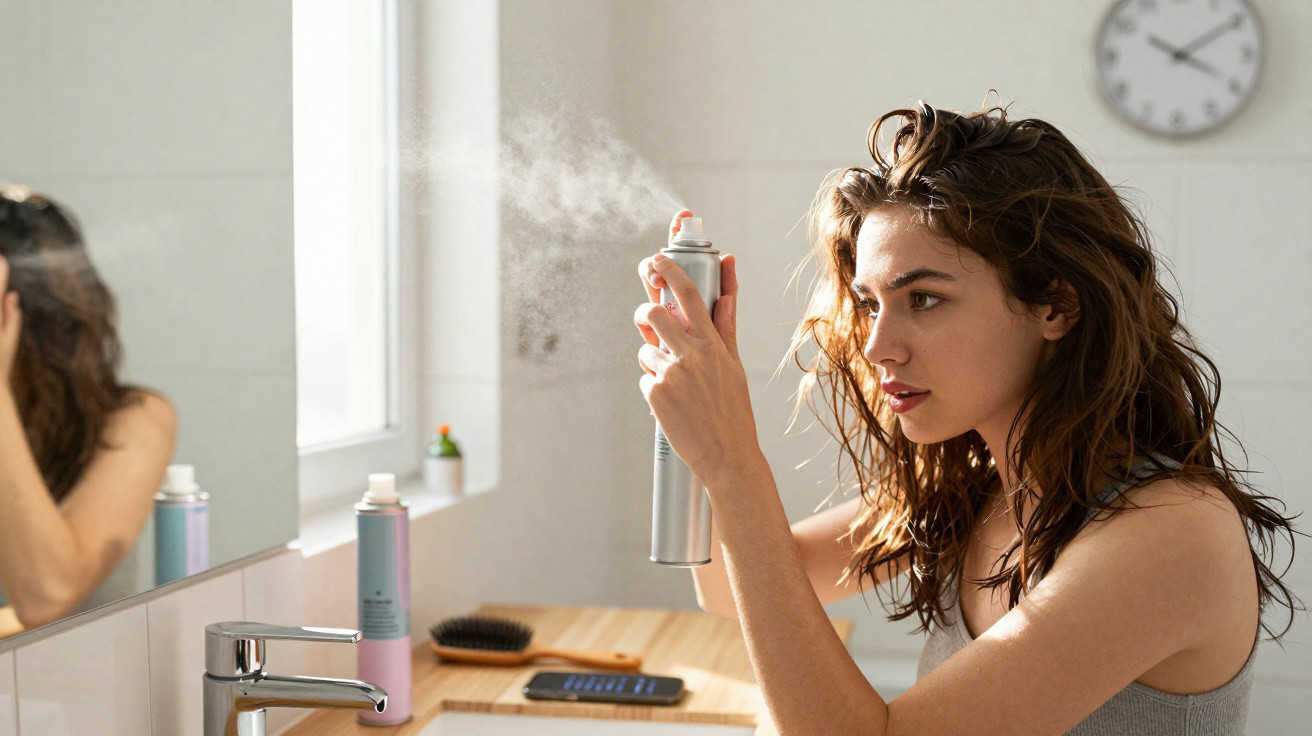
Some people rely heavily on products. They apply mousse beneath gel and finish with hairspray, hoping that extra hold will force the swirl down. More often, this produces a glossy, crunchy shelf of hair, framed by one or two defiant strands still rising at the hairline. Others take the opposite approach, using nothing at all and repeatedly brushing the cowlick down throughout the day, only to find it lifting once the hair dries in its natural formation.
A London stylist I spoke with laughed at how regularly this same situation occurs: a person walks in wearing a helmet of gel, with a glass-like fringe and a distinctive half-moon lift at the very front. “They think they have ‘bad hair’,” she said. “They actually just have a strong growth pattern and the wrong strategy.” For her, the answer never begins with product. It begins with heat.
Hair does not naturally settle in a certain direction by chance. Every strand has an internal structure: a cortex containing keratin chains connected by several kinds of bonds. Some are chemical and remain permanent unless the hair is permed or relaxed. Others, including hydrogen bonds, are weaker and can be reset with water and heat. A cowlick is essentially an area where many of these fibres are arranged in a spiral. Gel cannot reach those bonds. It only hardens the outer layer, like jelly set around a spring.
Applying gel directly to a dry cowlick asks the hair to remain in a position that conflicts with its own structure. As the product sets, the internal structure slowly takes over again and the strand shifts, even beneath its stiff coating. Hold is not the same as retraining. Heat from a hairdryer or hot styling tool, paired with direction and tension, temporarily alters the weaker bonds near the root. That is why a cowlick tends to respond only when warm air is involved.
How heat resets a front cowlick instead of more gel
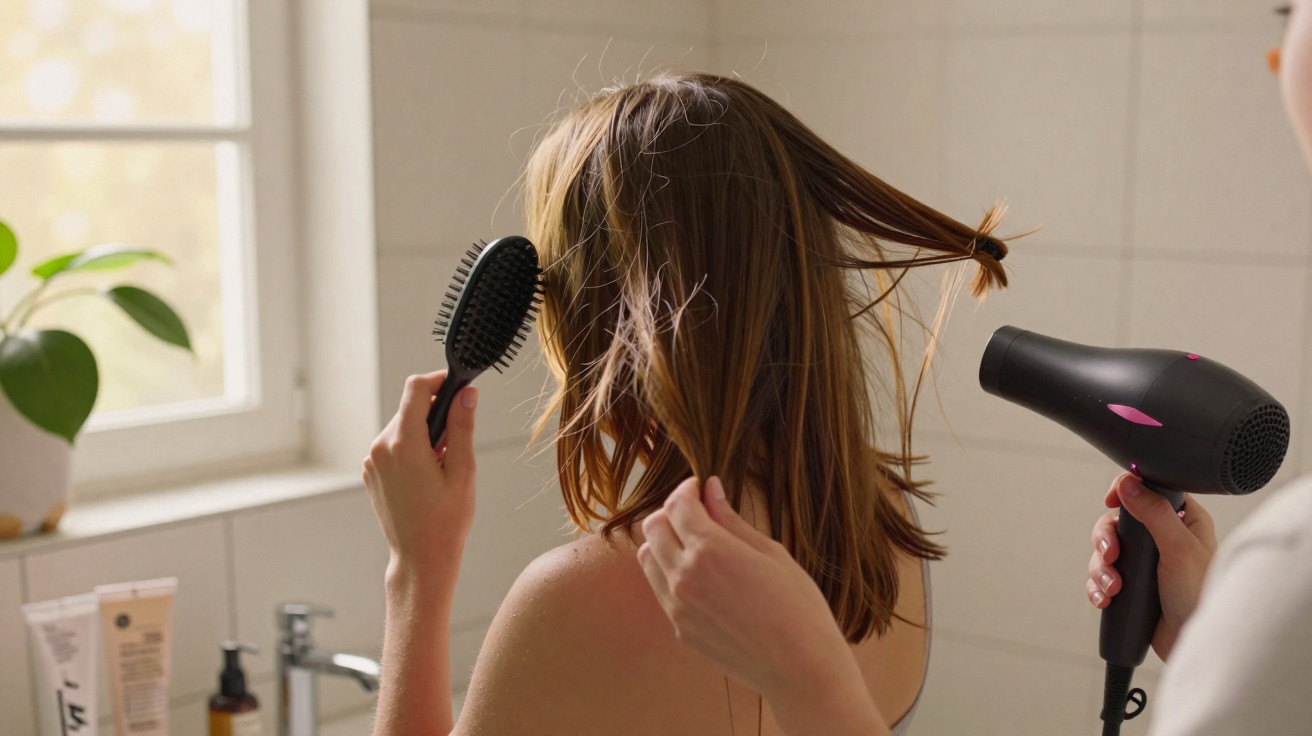
The nearest thing to a magic fix for a front cowlick is a straightforward routine on damp hair that concentrates solely on the first two or three centimetres at the root. Begin immediately after washing, once the hair has been towel-dried but is still noticeably wet at the base. With a small round brush, or simply your fingers, lift the cowlick section straight up from the scalp. Next, aim the hairdryer from the direction opposite to the swirl.
The goal is not to burn the hair flat. You are trying to disrupt its original spiral long enough to reset it. Use brief bursts of warm rather than extremely hot air, holding the nozzle close to the roots. Move the hair first one way and then the other, always lifting it away from the scalp while the root remains pliable. Finally, brush it in the direction you actually want - a side sweep, curtain fringe or straight back - then secure it with a quick blast of cool air.
Gel only becomes useful after this root work. By then, the hair’s internal bonds are temporarily arranged in your favour. A lightweight product can support the new direction rather than attempting to fight the old one.
On a difficult hair morning, it is easy to smother a cowlick in product and hope it works. Let us be honest: hardly anyone manages the correct technique every day. Many people simply smooth gel over the surface from front to back, without changing the direction of the roots at all. The top layer looks polished for a while, but the base remains curled into its original spiral, ready to force its way through.
Another frequent error is beginning when hair is already partly dry and fluffy. Once the hydrogen bonds have dried into the cowlick’s natural pattern, you are effectively styling over a set mould. Gel then forms a shell over that dried-in “memory”. The proper approach is almost dull in its simplicity: wet the cowlick roots, reset them with heat and direction, then use only a small amount of flexible hold.
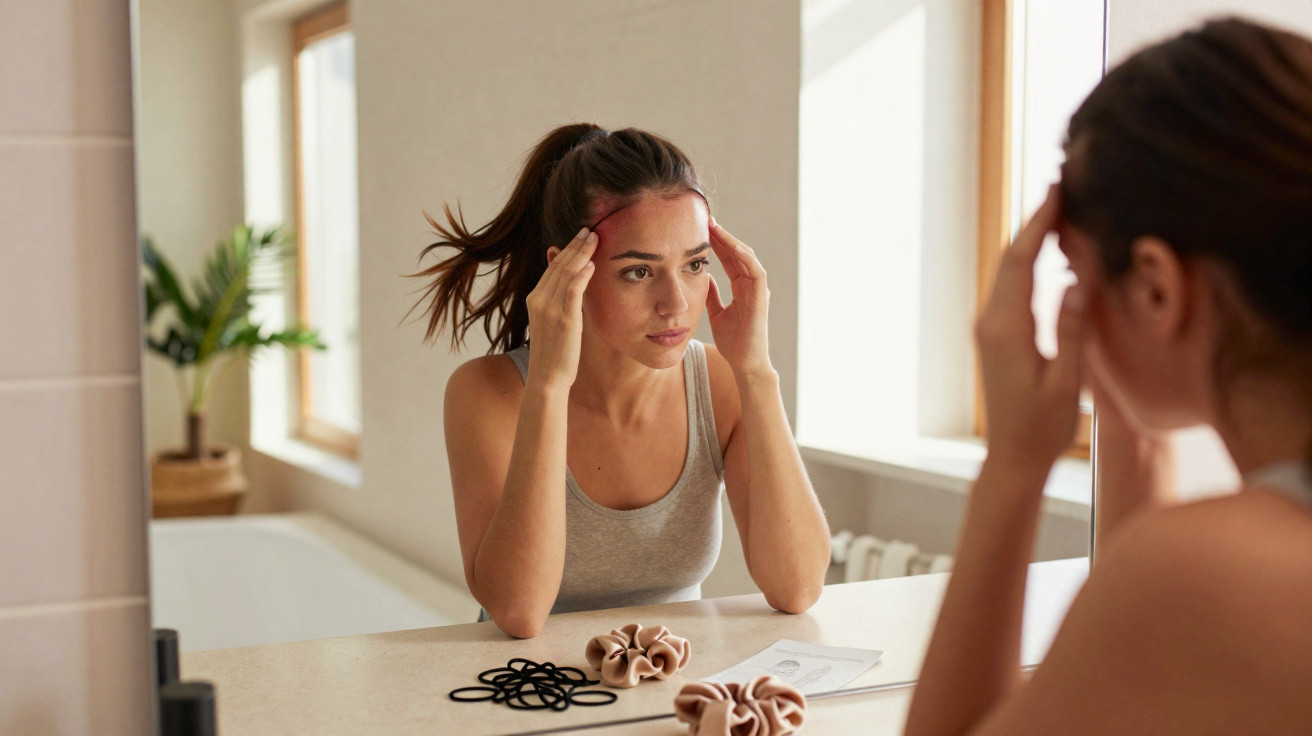
There is an emotional element, too. During a week of job interviews or throughout adolescence, a hairline that will not cooperate can feel like a personal failing. That little spiral becomes a daily confrontation in the mirror. The truth is, it is not you being “messy”. It is anatomy being loud in a very visible place.
“Gel freezes the surface. Heat persuades the roots,” a Paris-based stylist told me. “If you skip the persuasion step, that cowlick will always come back for its encore by lunchtime.”
A practical mini-toolkit for front swirls includes:
- A narrow nozzle for your hairdryer, allowing heat to be directed precisely at the roots.
- A vented brush or comb for lifting and redirecting those first centimetres.
- A lightweight, flexible product instead of an extremely hard gel for everyday use.
Together, these tools do not remove the cowlick. They show it a different trick for the day. That is a very different aim.
Living with the swirl instead of fighting it forever
Once you recognise that a cowlick is a growth pattern rather than bad behaviour, the struggle becomes less intense. It explains why your fringe parts in exactly the same place each day; why your side part looks brilliant from some angles but strangely puffed-up from others; and why that little front section rises even more in humidity or after exercise, when sweat rewets the roots and allows the original spiral to return.
Some people choose to style with the cowlick rather than against it. A pronounced left-front cowlick can provide the foundation for a dramatic side fringe. A centred swirl can create natural volume in a curtain fringe without teasing or backcombing. Barbers often treat the cowlick as a guide, cutting the surrounding hair a little shorter or retaining strategic length to soften or highlight its natural movement.
More privately, that persistent swirl can teach a quiet form of acceptance. You can redirect it for a day with heat, encourage it into a new path and reinforce it with gentler products. But you cannot truly remove the spiral from your scalp. On a rushed Tuesday, a quick blast from the hairdryer and a finger-comb may be all you can manage. On a Saturday with a major event, you may follow the full routine with brush, nozzle and a pea-sized amount of gel.
We have all had that moment when, after ten minutes of fighting, we look at our hair and think: “OK, this is how it will be today.” That acceptance is not necessarily defeat. It is a truce between your hair’s natural behaviour and what you would prefer it to do. The cowlick becomes less of a daily opponent and more of a signature: a little unpredictable, slightly alive and never entirely tamed.
You may begin noticing other people’s swirls on the Tube, in office meetings and on TikTok. That flawless influencer quiff? There is often a slight lift at the front where a cowlick is doing half the work. Your colleague’s consistently sharp pixie cut? Look closely and you will see how the stylist has shaped the cut around a front vortex rather than concealing it.
At its heart, hair is movement. A cowlick is simply movement that insists on departing from the script at the front of the stage. Heat allows you to rearrange the scene for a few hours. Gel gives the actors their marks. Yet the original choreography remains written in the follicles: patient and persistent.
That is why some people feel unexpectedly exposed when they finally grow out a heavy fringe and allow their front cowlick to show. Uncovered, the swirl becomes a small story of where their hair wants to go by itself. It may not be “perfect”. But it is unquestionably theirs.
| Key point | Detail | Why it matters to the reader |
|---|---|---|
| The root determines the shape | A cowlick is a spiral growth pattern anchored in the follicle | It shows that this is not “bad styling”, but hair architecture |
| Heat reprogrammes; gel sets | Heat affects internal bonds, while gel works only on the surface | It explains why a hairdryer can make the difference where gel alone fails |
| Work on damp hair | Redirect the cowlick while the roots are wet, then set it gently | It creates a longer-lasting result with less product and less frustration |









Comments
No comments yet. Be the first to comment!
Leave a Comment