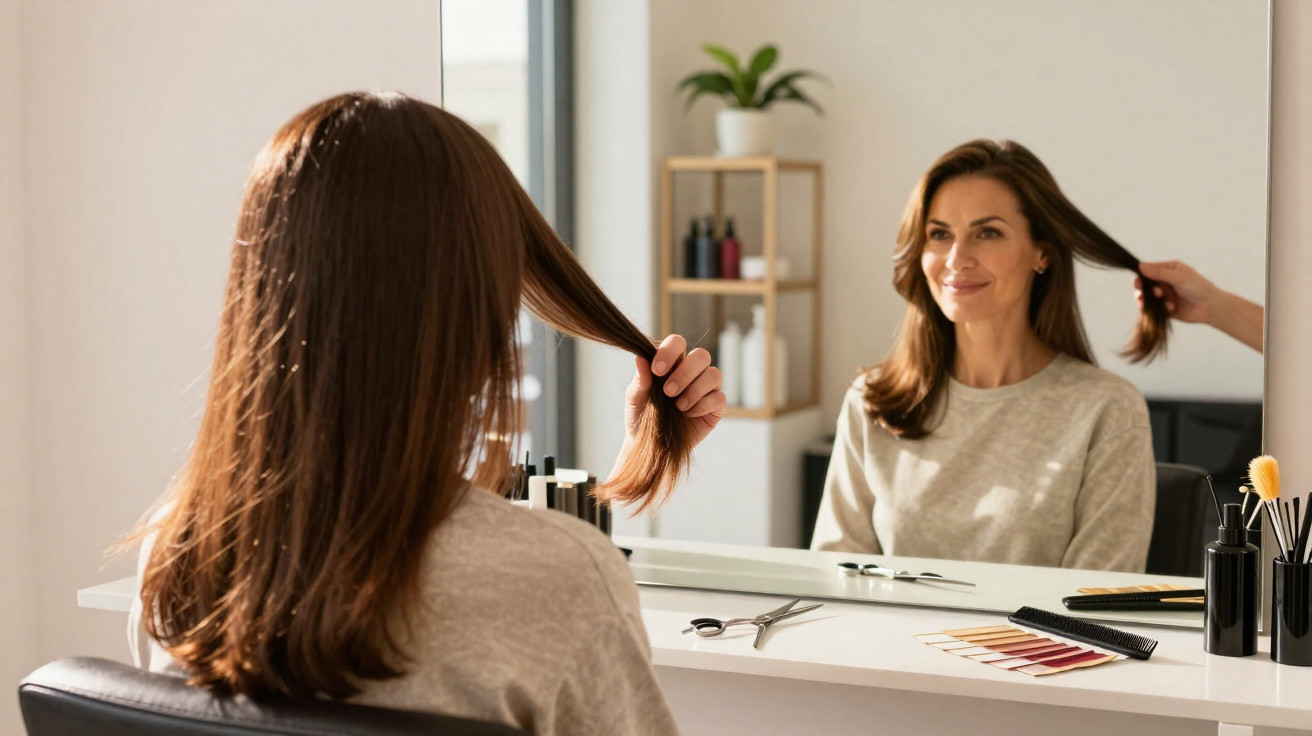
The woman sitting in the salon chair looked at her reflection with the particular blend of optimism and anxiety that hair can inspire.
The late-afternoon sun caught the highlights in her long ponytail, exposing each brittle tip and silvery-grey strand. “I feel like this length is ageing me,” she sighed, pulling at her hair. “But if I cut it, I’m scared I’ll look… old.”
Behind her, the hairdresser - a seasoned stylist whose scissors appeared to work almost instinctively - took her time before replying. She gently raised the client’s chin and studied her jawline, cheekbone height and the depth of her eyes. Then she made a small but telling move: holding the hair at several different lengths around the woman’s face, as though applying a live filter.
At one stage, the woman gave a quiet gasp. The salon fell silent.
Can hair length really affect how old you look?
Any experienced hairdresser will tell you that the right or wrong hair length can take years off - or add them on - within moments. This is not magic or a Hollywood transformation. It is closer to flattering lighting or a beautifully fitted jacket: it does not alter who you are, but it can change the first impression people take away.
Hair that is too long can pull facial features downwards, particularly around the mouth and jaw. Hair that is too short may sharpen angles, draw attention to lines and give the face a stern appearance. Between those two ends of the spectrum is often a length that creates a visual “lift”. The challenge is that this length differs from person to person.
A skilled stylist pays less attention to the hair itself than to the structure of the face: cheekbones, neck length and the way skin catches the light. Hair length simply creates the frame.
A London stylist I met keeps a collection of before-and-after pictures on her phone. Her preferred example shows a woman in her early fifties whose very long hair fell down her back. In the “before” image, the length drags the eye downwards, conceals her neck and makes her jawline appear softer and heavier than it really is.
In the “after” photograph, her hair has been cut just above the collarbone and shaped with long layers around the face. It is the same woman, with the same make-up and identical lighting. Yet she appears as though she has had a year of better sleep. Her eyes immediately become the brightest feature in the image. Her daughter, who attended the appointment with her, reportedly said, “Mum, you look like yourself again.”
This is not about looking younger in the sense of attempting to look 25. It is about looking less burdened. Salons say these medium-length changes are among the transformations clients notice most. They are the images people share, prompting friends to ask: “You look refreshed. Did you lose weight?”
Why is this in-between length so effective on so many faces? The answer lies in proportion. Hair ending between the jaw and collarbone reveals the neck while continuing to soften the lower half of the face. That visible area of skin between hair and shoulders opens the silhouette, which the eye often interprets as lighter, fresher and more energetic.
Very long hair, particularly when it is flat and cut to one length, can act like a curtain. It obscures the neck, visually narrows the shoulders and may accentuate heaviness or sagging around the lower face. Extremely short styles, when overly crisp or square, can expose every contour of the skull and every expression line.
The secret most experienced hairdressers share? The length that makes you look younger is usually the one that lets light reach your face again. It is not the length copied from a celebrity photograph.
The “younger” hair lengths hairdressers genuinely recommend
When you ask a professional, “Which length makes me look younger?”, they seldom reply with a precise number of centimetres. Instead, they begin with a test. Many will hold your hair at various points around your neck and shoulders as you face the mirror: at the chin, midway between the chin and collarbone, at the collarbone, and just above the shoulders. This is not merely salon conversation; it provides useful information.
For many face shapes, the most flattering area lies between the bottom of the ear and the top of the collarbone. Consider a soft long bob, a collarbone-length cut or a layered mid-length style with movement. Often, the front is left fractionally longer than the back, preserving flow rather than making the cut look rigid. That subtle angle can separate “fresh” from “helmet”.
One principle used by many stylists is simple: however short or long your hair is, the more youthful you wish to appear, the more softness and movement you need around the face.
Most of us know someone who “finally cut it” after years of insisting she never would. A Paris hairdresser told me about a client in her early sixties who came in with waist-length hair that had become thin. There was nothing inherently wrong with it. It simply suggested that she was reluctant to let go.
Together, they chose a style just below the shoulders, with soft layers and a light fringe that could be swept to one side. It was not a dramatic change. The client had one request: “I don’t want to fight with my hair every morning.”
Two hours later, she looked as though she had just returned from a lengthy break. Her neck seemed longer, her jawline appeared more defined and her hair looked twice as full, simply because the length was no longer weighing the strands down. As she left, she paused at reception and said: “I thought short hair would make me look old. I was wrong. The long hair was shouting my age louder than my face.”
There is a psychological element too. When your hair takes five minutes rather than twenty to style, you are more likely to style it at all. Even a quick dry with a little movement generally looks more youthful than perfectly long hair left hanging because there was no time to deal with it.
What, then, about the classic short cut so many people fear? Many experienced hairdressers believe ultra-short hair can be remarkably rejuvenating, provided the facial features suit it and the cut includes softness. Micro-pixies without softness around the hairline can add years by highlighting fatigue or hollow areas around the temples and eyes.
A slightly longer pixie, however, with texture through the top and soft side sections grazing the cheekbones, can produce the reverse effect. It creates lift and shows off bone structure in a flattering manner. Short doesn’t age you. Harsh does. And long does not necessarily protect you either. Heavy does.
In the end, the hair length that makes you appear older is the one that conflicts with your face and your lifestyle. The length that makes you look younger works with the way you move, prepare for the day and genuinely live.
Choosing your “younger” length with a hairdresser you trust
The method many stylists rely on most begins before a single strand is cut: the pinned-up test. While you sit in the chair, they use clips to imitate a range of lengths and shapes. First, they may bring the hair to chin level, then just below the jaw, then to the collarbone. At each point, they ask you to look directly into your own eyes in the mirror.
Pay attention to where your focus naturally lands. With certain simulated lengths, your gaze may go straight to your jaw or the lines around your mouth. With others, you may notice your eyes or cheekbones first. Keep looking at the lengths that make your eyes stand out. This is generally your rejuvenating zone. Your “younger” length is the one that gives the spotlight back to your expression.
There is another useful detail: observe the shadow around your neck. If the hair ends at the fullest part of the neck, it may form a visual barrier. When it falls just above or just below that area, it can make the neck appear slimmer and longer.
Most people bring online inspiration images to the salon, which is perfectly reasonable. The problem often starts when we become attached to those pictures and overlook real life. On a Tuesday morning, your hair is unlikely to resemble a brushed-out editorial blow-dry. You may have five minutes before a video call while a child asks where their shoes are. Let’s be honest: nobody really does that every day.
This is why experienced hairdressers ask seemingly irritating questions such as, “How often do you actually dry your hair?”, “How does it look when it air-dries?”, and “What’s your natural texture?” They are not being critical. They are preventing you from choosing a cut that requires an additional 30 minutes every morning just to look right. Few things make you feel older faster than a hairstyle you can never quite manage to style properly.
There is also an emotional side to it. Some people fear cutting too much, while others worry about not cutting enough. Clients may cling to a length that no longer flatters them because it is connected to who they were at 20, 30 or “before the kids”. Others make an impulsive chop after a break-up, then feel unfamiliar with hair that suddenly sits above the ears.
One experienced stylist put it this way during a hectic Friday afternoon:
“Hair length is emotional first, technical second. My job is to find the length where you recognise yourself… and like what you see.”
For anyone weighing up the decision, this simple mental checklist can help:
- Your hair appears fuller when it is a little shorter than its current length.
- Your features become more noticeable when your hair no longer sits across your chest.
- You are drawn to a bob but nervous about making the commitment - a collarbone cut offers a trial run.
- You wear your hair tied up every day - your true “length” is your ponytail, not the hair down your back.
- You leave the salon with a bigger smile when there is softness and movement around your face.
Rethinking age, face and hair: it is not only about centimetres
When someone asks, “Which hair length makes you look older?”, the deeper question is often: “Which version of me do other people notice first?” That is why no fixed rule - such as “long hair ages you after 40” or “short hair is always more mature” - can provide the answer. Those clichés fall apart as soon as you look around any busy city.
What experienced hairdressers observe every day is that styles most likely to age someone are the lengths that conceal expression, restrict movement or rely on styling routines that nobody can realistically maintain. Lengths that read as younger keep the eyes visible, leave the neck open and retain lively texture. They make room for imperfection: a little wave, a slightly tousled bend or an undone fringe can all suggest energy rather than tiredness.
On a more personal level, the most effective “younger” cuts often appear when someone accepts who they are now - not the person in an old photograph, nor the person they believe trends tell them to be. One experienced colourist told me she can usually tell within the first five minutes of a conversation whether someone is about to have a haircut that liberates them or one they will regret a week later.
We have all experienced a moment when a straightforward hair change makes the entire day feel lighter. Not because anybody comments on it, but because the reflection suddenly resembles the version of you who still laughs loudly, moves quickly and makes plans. That is the understated power of the “right” length.
Perhaps, then, the next time you sit in a salon chair, the question should not be “Should I go short or stay long?”, but “What length lets my face tell the story I genuinely feel inside?” Somewhere between your jaw, your collarbone and your comfort zone, there is probably a cut that does exactly that. Once you find it, you do not simply look younger. You look unmistakably, and rather wonderfully, like yourself.
| Key point | Detail | Benefit for the reader |
|---|---|---|
| “Rejuvenating” length zone | Between the jaw and collarbone, with movement and softness | Helps you ask for a cut that brightens the face without requiring a radical change |
| Mirror-and-clips test | Simulate different lengths before cutting | Lets you see immediately which lengths weigh down or energise your features |
| Importance of lifestyle | Choose a length you can realistically style each day | Reduces frustration and makes it more likely that you will look “fresh” every day |















Comments
No comments yet. Be the first to comment!
Leave a Comment