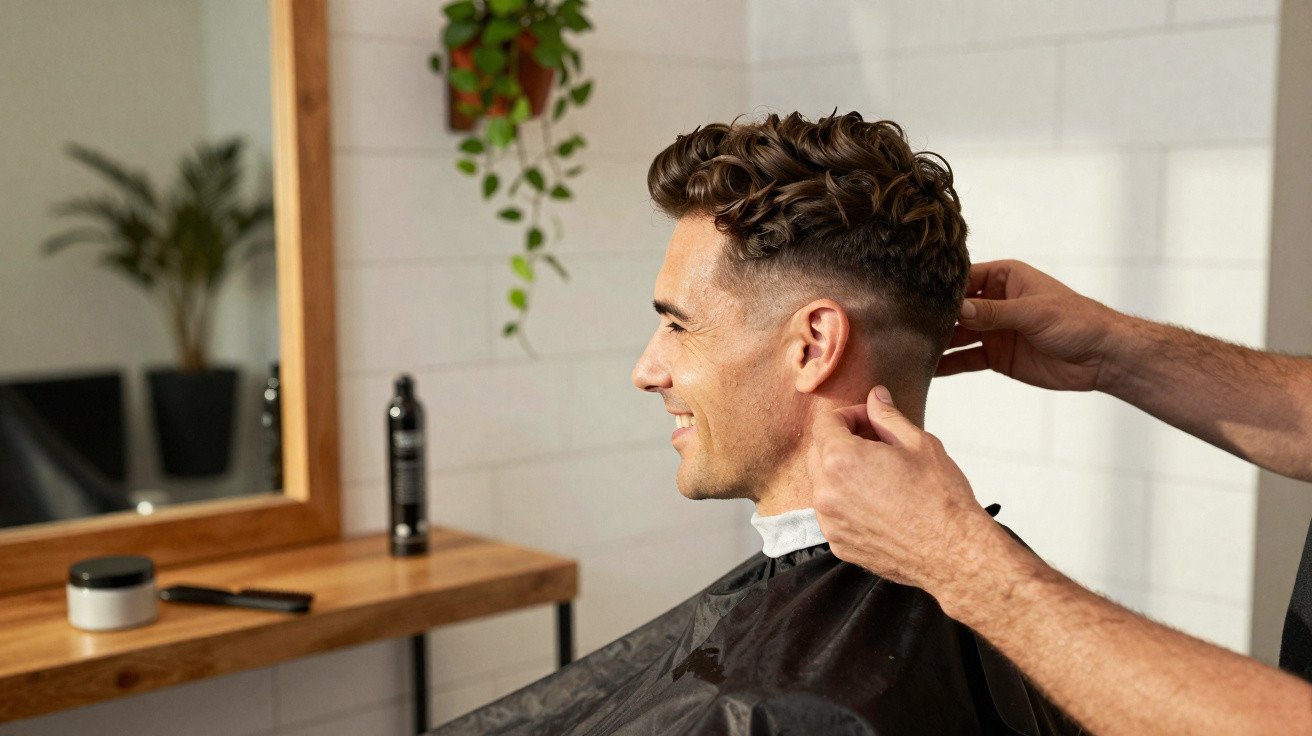
Two hours ago, a man with a gelled hairstyle that had started to look tired was sitting here; now, the person facing him looks more 38 than 47. The sides taper softly, while the top is loose, almost as though he had simply woken up like this. “Blimey, is that really me?” he says, carefully touching the new outline. The barber merely nods, as if it were nothing unusual. Yet in that moment, it is clear that this is about more than a haircut. It is that small rush of thinking: I can reinvent myself without looking ridiculous.
Why the soft undercut appeals so strongly to men over 40
There is a point in life when many men suddenly realise that the mirror has become less forgiving. The hairstyle that still looked “businesslike” at 30 can look stuck in a rut by 42. This is where the natural, soft undercut comes in. It removes the severity, makes the lines more relaxed and adds a subtle sense of cool to the face. It is neither loud nor forced. More like: “I look after myself, but I do not make a fuss about it.”
Many men describe their feelings after the first cut as a small sense of relief. Suddenly, the forehead feels more open, the shorter sides make the face appear slimmer, and fine lines look less harsh. It is remarkable how a few millimetres less at the sides and a little more texture on top can alter someone’s whole presence. That is exactly what appeals to men who are no longer interested in chasing youth, but equally do not want to say, “It does not matter, I am just old.”
A hairdresser in a Cologne salon recalls one Monday when she gave five men over 40 almost the same cut, one after another. Their jobs and lives were different, but they all wanted the same thing: to look more current without resembling their own sons. One arrived with a screenshot of an actor, another with a TikTok video from a barber, while the third simply said: “I do not want to look like an insurance salesman any more.” In the end, they all chose this softer undercut version: shorter sides, gently blended transitions, movable hair on top and barely any visible product.
An internal review by a large franchise chain indicates that requests for a “soft undercut” among men aged 38 to 52 have risen significantly over the past two years. It is not a scientific study, but rather a barometer of real life. That is precisely what makes it interesting. Something is quietly changing: away from the heavily fixed side parting and towards a style that looks more like today - and less like 2009.
Why does it work so well? First, proportions play a major part. When the sides are shortened softly, the face appears more defined and the jawline clearer. This naturally creates a more youthful impression, without Botox or filters. Secondly, the soft undercut relies on texture and movement. Hair that does not stand rigidly in place but can shift slightly looks more like an “active everyday life” than an “office chair”. Let us be honest: nobody spends 20 minutes blow-drying their hair into perfection every morning. A haircut that looks best in that slightly unfinished state fits surprisingly well into our lives.
How to achieve a natural, soft undercut without styling stress
The key starts in the barber’s chair, not in the bathroom. Do not just ask for an “undercut”, or you may quickly end up with hard edges and a gaming-streamer look. Be clear about what you want: slightly shorter sides, no shaved-to-the-skin edge, a softly blended transition, and two or three centimetres of flexibility on top, depending on your hair type. Show a photo where the outlines are not sharply shaved but gently tapered. Also say honestly how much styling you are willing to do - many barbers will automatically create a cut that is too complicated if you do not mention it.
At home, a very small amount of cream or paste with light hold is usually enough. No concrete-like gel and no high-shine gunk. Rub the product between your hands first, as if applying invisible lotion. Then run your fingers through dry or slightly damp hair, always working from back to front. Two or three movements and you are done. The haircut should look as though you have lived your life in it, not spent three hours in the bathroom creating it.
One classic mistake after 40 is pulling everything into place too neatly for fear of looking “messy”. The parting is drawn as if with a ruler, and every strand follows an invisible set of rules. That strips the look of its ease. Leave a little irregularity in place: a strand lying slightly across, or roots that are not completely fixed down. We all know the moment when we look in the mirror and think, “That is right”, then ruin it with two more movements because it is meant to look “even more perfect”.
A second stumbling block is using the wrong amount of product. The finer the hair, the less product is needed. Otherwise, it looks flat and ageing. Thicker hair needs a little more, but it should be spread through rather than applied in one spot. And honestly, if styling takes more than 40 seconds a day, it simply will not be maintained in everyday life. Let us be honest: nobody really does that every single day. That is why any haircut that still lands in a reasonably good place with one quick movement wins out.
“Many men over 40 think they have to choose: either completely serious or desperately youthful. The soft undercut shows them there is a third option - well-groomed, relaxed, mature.” – Owner of a men’s salon in Munich
- A gentle transition rather than a hard line – looks less deliberately styled and flatters more mature facial features.
- Light texturising products rather than gel – create movement without making the hair sticky or shiny.
- A regular trim every 4–6 weeks – prevents the look from suddenly turning back into a block cut.
What this soft undercut haircut does to your self-image
It becomes interesting when you meet the same men again a few weeks later. The new cut has slipped into their everyday lives without any great drama. One says colleagues told him he had “somehow got a holiday face”. Another says his daughter suddenly wanted to take a selfie with him of her own accord. It may sound trivial, but these small moments shape whether we feel we are still “right in the middle of life” or already moving ourselves to the substitutes’ bench.
The natural undercut is not a magic wand for midlife questions, but it sends a quiet message to the world: “I have not stood still.” Men with significant professional responsibility in particular use a look like this as an update button. They do not need a radical image change or Joker-green colouring. They want a cut that feels like new trainers with familiar jeans: understated, yet noticeably different. And that sense of being “noticeably different” often leads to more motivation for sport, new clothes and sometimes even career decisions.
Perhaps that is also where its strongest effect lies: the soft undercut pretends to be “just a hairstyle”, while actually adjusting how someone sees himself. Men who have hidden beneath an old-fashioned haircut for years rediscover their faces. Wrinkles are not cut away, but they appear in a different frame. It works like a filter from real life. Suddenly, it becomes clear that youthfulness is less a question of wrinkles than of attitude - and of having the courage to allow small changes.
| Key point | Detail | Benefit for the reader |
|---|---|---|
| Soft undercut instead of hard outlines | Gentle transitions, shorter sides, movable hair on top | A more youthful-looking, relaxed style without chasing youth |
| Simple styling routine | Light paste, 30–40 seconds of finger styling | Practical for everyday life, including for men with little time or interest in styling |
| Psychological effect | A new self-image and a more relaxed presence | Builds confidence and presence at work and in private life |
FAQ:
- Question 1: Does the soft undercut suit a receding hairline?
Yes, it can work particularly well in that case. The sides are kept a little shorter, while the hair on top remains softer and is styled so that the hairline is visually integrated rather than emphasised.- Question 2: How often should I get it trimmed?
Every 4 to 6 weeks is ideal. This keeps the transitions tidy without requiring you to start again with a completely new hairstyle.- Question 3: Does the look work with slightly grey hair too?
Absolutely. Grey often looks especially modern in this natural version, because the cut highlights texture and makes the grey appear more like a style statement.- Question 4: Which products are most suitable?
Light pastes, creams or clay with a matte finish. Avoid highly glossy gels, as they can quickly make the look seem old-fashioned and artificial.- Question 5: Can I style the cut myself if I am not good with my hands?
Yes. Ask your barber to show you exactly which three hand movements they use. If the cut has been done well, a little product and a quick tousle in front of the mirror will usually be enough.









Comments
No comments yet. Be the first to comment!
Leave a Comment