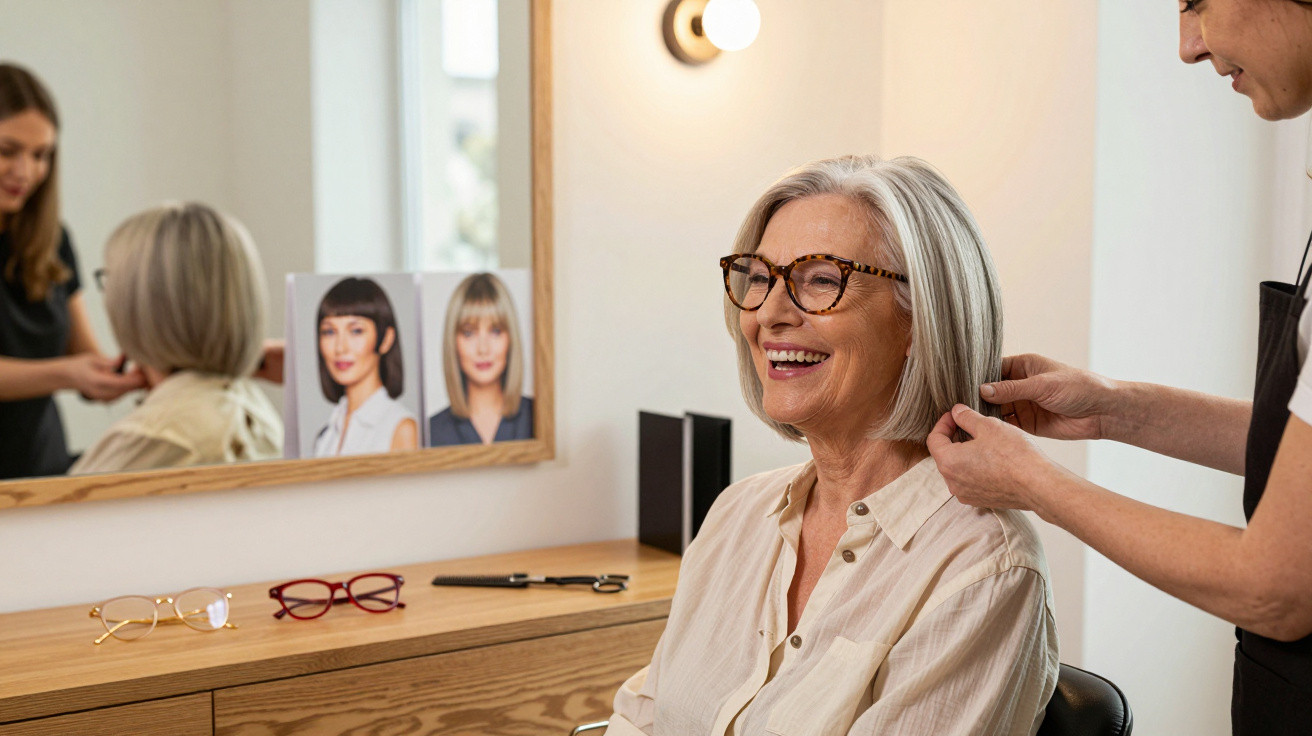
The salon was already busy when Jeanne opened the door, her glasses lightly misted from the chill outdoors. At 72, with an overgrown silver bob and the slight uncertainty familiar in women who have kept the same style for two decades, she looked first at the mirror and then at the frames resting on her nose. “I’d like something that doesn’t make my face fall,” she whispered to the hairdresser, partly in jest and partly in earnest. Nearby, other women in their seventies were making the same quiet assessment: hair, lines, lenses and jaw.
One unspoken question seemed to fill the room.
Can a straightforward haircut, selected to work with your glasses, genuinely make you appear younger?
The overlooked rule: your frames belong in the haircut decision
After 70, the biggest difference often comes from more than the haircut alone. It lies in the partnership between your hair and glasses. Many women discuss a “new cut” while overlooking the fact that their frames create the first visible line on the face. When the hairstyle competes with that line rather than complementing it, it can make features appear harsher.
The eye is immediately drawn to contrast. Blunt fringe paired with square frames, for instance, may make the upper face look heavier and draw attention to drooping eyelids. Softer layers that mirror the curve of the glasses, by contrast, can visibly reshape the expression.
This is why the most rejuvenating haircuts after 70 begin with one question: what shape is sitting on your nose every day?
Consider Maria, a 74-year-old retired teacher who came to her salon carrying a photograph of a celebrity pixie cut. The model in the image was not wearing glasses. Maria, however, wears thick rectangular frames for progressive lenses. Her first pixie was cut too short and close at the temples, so it fought against the frames and made her seem sterner than she felt.
Her hairdresser paused, repositioned Maria’s glasses herself and took another look. For the second attempt, she created a marginally longer pixie, with a wispy fringe that followed the upper edge of the frames and some lift at the crown. Her forehead instantly appeared gentler, her cheeks seemed raised, and the glasses looked like part of the look rather than a medical object.
She left the salon half-laughing: “I’ve had these glasses for ten years and it’s the first time they look intentional.”
From a visual point of view, the face is made up of horizontal and vertical lines. Glasses introduce two pronounced horizontal lines: one across the eyes and another at the tops of the cheeks. A successful haircut after 70 avoids adding further heavy horizontal lines in that same area, choosing instead to interrupt or soften them. This is why a severe, blunt bob ending exactly at chin level can sometimes pull the face down when worn with thick frames.
What tends to work more effectively? Styles built around diagonal lines and lightness: side-swept fringes that pass over the corner of the glasses, layered sides that uncover the cheekbones, and cuts at the nape that reveal a little neck. Age does not rule out a modern look. It simply makes overly rigid styling around the lenses less forgiving.
Treat your frames as the initial sketch, with your hair as the watercolour painted around them.
The 4 best rejuvenating haircuts after 70 when you wear glasses
At the top of the list is a soft, layered bob falling somewhere between the jaw and the base of the neck. This is not a traditional helmet-like bob, but a lighter interpretation with subtly tapered ends. Worn with glasses, it opens up the lower face and prevents the “square-on-square” effect that can age so many women.
Ask your hairdresser to add gentle layers around the face, particularly at the temples. Round or oval frames pair well with lengths that turn slightly inwards, which can visually raise the cheeks. For more rectangular glasses, a little outward movement helps prevent the overall style from looking excessively geometric.
This bob is especially flattering with a long, airy fringe that brushes the upper edge of the glasses while leaving the eyebrows visible.
The second standout option is a soft pixie with height at the crown. Avoid an extremely short, military-style crop that may harden the face; instead, opt for a feminine pixie with longer pieces through the crown and gently textured sides. For a woman over 70 who wears glasses, it exposes the neck, opens up the eye area and brings an immediate sense of energy.
Picture Françoise, 79, with small round glasses and a reserved smile. She had spent years concealing herself behind a flat, medium-length style held back with a clip. When her hair was transformed into a soft pixie, her hairdresser created a delicate quiff above the frame line and softened the sideburns. The change was almost startling: her glasses appeared lighter, her mouth looked less tense and her eyes became far more noticeable.
She did not look younger “at all costs”. She looked alert. In the mirror, that makes all the difference.
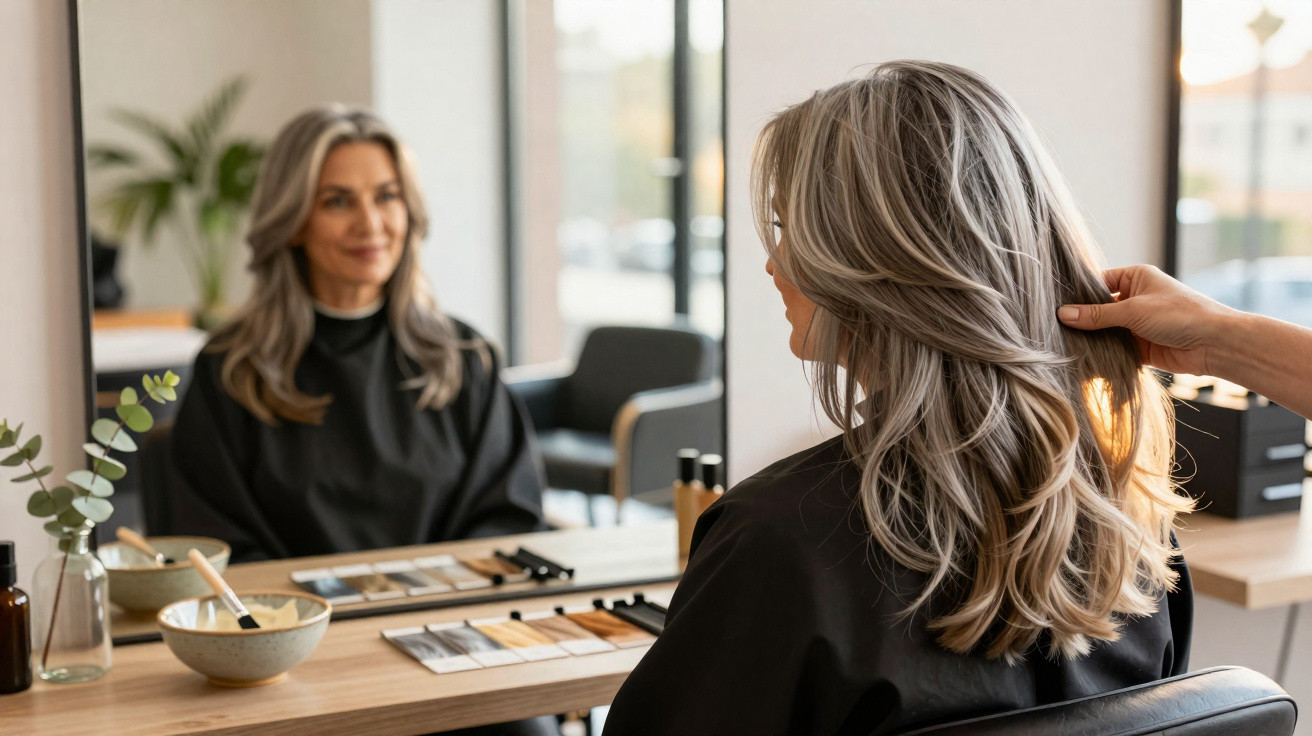
A third highly effective choice is a shoulder-length cut with a curtain fringe, particularly for women with thin or understated frames. The hair falls between the collarbones and shoulders, creating movement that directs the eye downwards and away from the lower face, where the skin may be less firm. Parted centrally or just off-centre, the curtain fringe frames the lenses instead of competing with them.
The fourth strong option is a structured short cut with a long side-swept fringe. It is ideal for bold or colourful frames. The sides remain tidy and follow the temple line, while a substantial fringe moves diagonally across the forehead and just grazes the frame. That diagonal acts as a small facelift in its own right, disrupting rigid horizontal lines and softening expression lines.
In reality, nobody styles their hair perfectly every single day, but even when roughly arranged with the fingers, these four styles retain a modern and flattering silhouette.
How to speak to your hairdresser so your haircut and glasses work as one
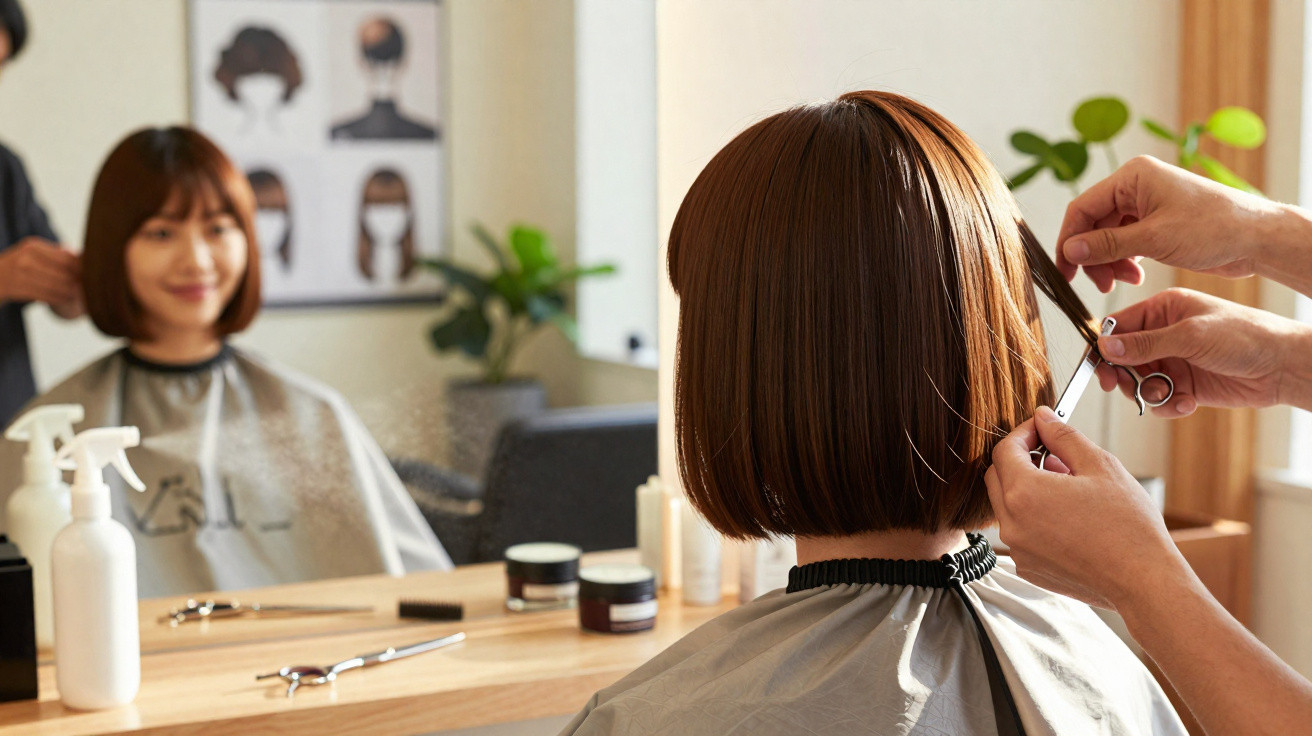
Arrive at the salon wearing the glasses you use every day rather than carrying them in your bag. Before anyone touches your hair, sit down and study your face directly in the mirror. Lift and lower your chin, then turn your head from right to left. This brief routine shows where the glasses divide the face, where the hair appears too weighty and which areas you would like to “light up”.
Once the hairdresser comes over, try not to rely on vague requests such as “something to rejuvenate me” or “I trust you”. Use your finger to be specific: “Here, at this corner of the glasses, I feel weighed down. Here, above the frame, I’d like more softness.” Precise language makes a tailored cut easier to achieve, especially after 70, when every millimetre around the eyes matters.
Request that the length is cut and checked while you are wearing your glasses, rather than with them removed. This seemingly small point makes a major difference to fringes and side sections.
Many women over 70 feel they need to apologise for wanting a change: “At my age, does it really matter?” It does, for a simple reason: you still meet your reflection every morning. An unsuitable cut may intensify the appearance of tiredness, whereas a well-chosen one can softly diffuse it. That is not vanity; it is comfort.
One common mistake is requesting an identical haircut to that in a photograph of a woman without glasses, then feeling disappointed when the frames seem to “age” the result. The problem is not you, but the disconnect between three factors: the cut, the glasses and the face. Another familiar error is holding on to very long hair “because my husband likes it” while tying it back daily to keep it clear of the frames. This can pull the features downwards and leave the forehead exposed in a severe way.
You are entitled to say: “I want something practical that I can style in three minutes, but that doesn’t close my face behind my glasses.”
“Past 70, the best haircut isn’t the one that erases your age. It’s the one that aligns your hair, your frames, and the woman you’ve become,” says Claire, a Paris-based stylist who works mostly with clients over 65.
- Soft layered bob (jaw to neck): Most suitable for round or oval frames. Include light face-framing layers and slightly curved ends. It introduces movement without making the jawline appear harder.
- Feminine pixie with crown volume: Best suited to medium or thicker frames. Keep it short at the nape and airy through the top. It reveals the eyes and lets the glasses function as an accessory.
- Shoulder-length with curtain fringe: Ideal for discreet or rimless glasses. It diverts attention from the lower face and brings focus towards the eyes and cheekbones.
- Structured short cut with long side fringe: Excellent for bold or coloured frames. Maintain neat sides and add a diagonal fringe that crosses the upper line of the glasses gracefully.
A new style era: wear your glasses as jewellery, not a burden
A change happens when women over 70 stop viewing glasses as something to conceal and begin treating them like earrings or a necklace. The haircut is no longer camouflage; it becomes a frame around another frame. This is when softness can return to the face. Suddenly, silver hair, fine wrinkles, the choice of glasses and the shape of the cut all communicate the same story.
Most of us know the moment of unexpectedly catching our reflection in a shop window and wondering, “Is that really me?” A suitable cut, designed around the glasses, can turn that shock into a calm “Yes, that’s me, actually.” It is not about looking younger at all costs, but about feeling more aligned.
Perhaps genuine rejuvenation is not about taking years away, but about adding intention. What if your next hair appointment focused less on age and more on claiming your place, glasses and all?
| Key point | Detail | Value for the reader |
|---|---|---|
| Think in duos: hair + glasses | Select styles that repeat or soften the lines created by your frames | The face appears more open and balanced, without harsh “makeovers” |
| Favour soft movement and diagonals | Layered bobs, curtain fringe, side-swept pixies, structured short cuts | A visual lifting effect with less attention drawn to areas of sagging |
| Communicate differently at the salon | Show your glasses, identify “heavy” zones precisely and ask for checks with the glasses on | A greater likelihood of leaving with a genuinely rejuvenating cut that is easy to live with |


Comments
No comments yet. Be the first to comment!
Leave a Comment