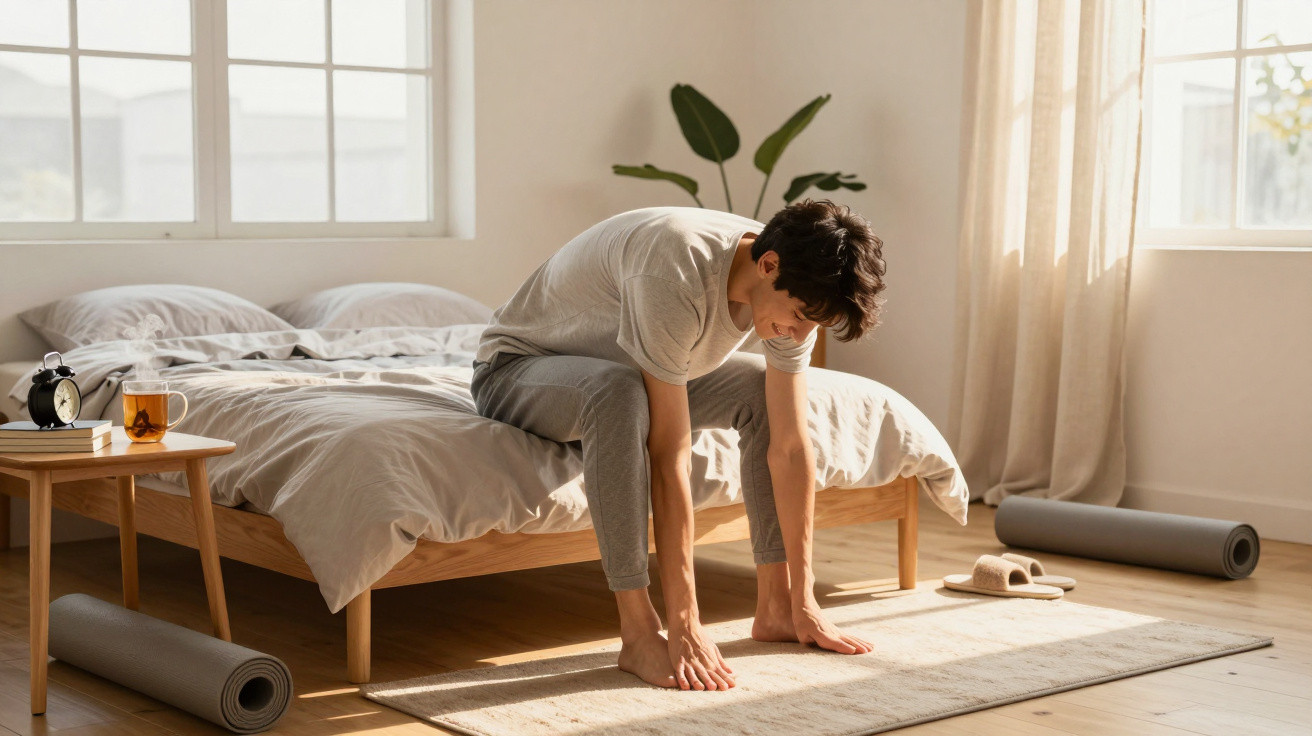
The alarm sounds, and instead of thinking “Good morning,” your first thought is “My neck.” Next comes the usual lower-back stiffness, then the muted pain in your shoulders after last night’s late scrolling. You stretch briefly, something clicks, and you tell yourself that today you will sit properly, drink more water and move more.
Ten minutes on, you are curled over your phone, absorbed in emails and news notifications.
By midday, your body resembles a poorly folded chair, and you find yourself wondering when simply “being awake” began to feel like an athletic event.
Somewhere amid the disorder and the diary, your routine is quietly determining how comfortable your body feels.
When your body begins following a rhythm
At some point in the day, you can tell whether your body is working with you or against you. It may happen as early as when you bend down to tie your shoes. Your back tugs, your hamstrings object, and getting yourself upright suddenly feels like a negotiation with your own body.
On other mornings, fastening those exact same shoes is easy. You bend, straighten and move with barely a thought. Nothing dramatic. Just… effortless.
That contrast seldom comes down to a miraculous smoothie or a magic mattress. More often, it is the result of modest, unexciting routines that your body has gradually learned it can rely on.
Consider Elena, 39, who works in marketing and spends much of the day at her laptop. For years, her evenings followed an identical pattern: a heating pad on the sofa, scrolling with a painful neck and telling herself this was simply how “getting older” felt.
One winter, she unintentionally adopted a new habit. Rather than dropping onto the sofa, she started taking her dog for a 15-minute walk at the same time every evening. The same route, the same playlist, the same jacket. A few weeks later, she noticed an unexpected change. Her back no longer screamed at her during meetings, and her shoulders remained more relaxed.
Nothing else was different. Her job was the same. So was her chair. There was simply one small, consistent ritual that stopped her body from locking into a single permanent position.
Our bodies respond well to predictability. Joints cope better when they can expect a little daily movement. Muscles recover more quickly when bedtime is fairly consistent. Digestion functions more smoothly when meals arrive at roughly regular times.
This is not about treating discipline as a moral virtue. It is about biology responding positively to rhythm. When movement, rest and nourishment happen repeatedly, your nervous system settles. Tension eases. Pain does not shout quite as loudly.
Physical comfort isn’t usually about doing more; it’s about doing a few small things again and again until your body believes you.
Small rituals that gently reset your body
One of the easiest physical comfort routines begins before you have even left the bedroom. Sit at the side of the bed, place both feet on the floor and take three slow breaths while keeping your shoulders loose. Next, carefully roll your neck, circle your ankles and reach your arms overhead as though you are trying to become one centimetre taller.
It takes under a minute. In effect, you are telling your body, “We’re switching on now, but gently.” With time, this small practice can ease morning stiffness and soften the jolt of moving from lying down into full-speed life.
It seems too minor to make a difference, but that is precisely its strength. You are far more likely to repeat something that does not feel like a major undertaking.
The same principle applies during your working day. Rather than trying to maintain an ideal “I’ll move every 30 minutes” timetable, choose one straightforward prompt. For instance, whenever a meeting ends, stand and walk to the kitchen and back. No step target. No pressure from a fitness tracker. Only a pattern.
We have all had that realisation that we have not left the chair since 9 a.m., and our hips feel as though they have been welded in place.
A kind routine can interrupt that pattern without making you feel guilty. Naturally, you will forget at times. You may miss the walk, have lunch at your desk or spend the afternoon slumped over. Honestly, nobody does this perfectly every day. That does not remove the value of the days when you manage it.
“I stopped chasing motivation and started chasing repetition,” says Jonas, 46, who swapped chronic neck pain for a two-minute stretching ritual before bed. “The stretches are boring. The comfort isn’t.”
- Wake-up ritual: Spend 30–90 seconds doing gentle stretches before looking at your phone.
- Movement anchor: Connect a brief walk or stretch to something you already do, such as making coffee, attending meetings or taking calls.
- Comfort check-ins: Three times daily, spend 10 seconds noticing your posture, jaw and breathing.
- Wind-down cue: At the same time each evening, lower the lights and do one quiet activity to signal “off” to your body.
- Snack rhythm: Have regular, uncomplicated snacks or meals so your energy and mood do not crash into your joints.
Making physical comfort feel like home
Physical comfort rarely appears after one major decision. Instead, it arrives through repetition: the glass of water placed on your desk each morning; the five-minute walk after lunch, even when the weather is irritating; the habit of setting your phone aside 20 minutes before bed so your eyes and shoulders can relax.
On paper, these habits can sound ridiculously basic. Live with them for a month, though, and you may notice that your neck clicks less and your lower back no longer complains whenever you get up. What was boring starts to feel like understated magic.
The real shift happens when these tiny actions no longer feel like “healthy tasks” and instead become ordinary. Like brushing your teeth or locking the door, they are not up for debate; you simply do them. Your body begins to relax into the expectation that you will look after it consistently rather than randomly.
That is when comfort ceases to be a weekend ambition and becomes the foundation of your weekdays.
You do not need a flawless plan. You need a rhythm that genuinely fits into your real life.
Perhaps, then, the more useful question is not “How can I fix my back/neck/shoulders?” but “What’s one tiny thing I’m willing to repeat daily for the next month?” Could it be a 60-second stretch, standing during one call each day, or going to bed 15 minutes earlier on weeknights?
Your routine will not look polished on Instagram. It will be inconsistent, imperfect and sometimes forgotten. Still, your body will notice.
If you pay attention, you may notice too.
| Key point | Detail | Value for the reader |
|---|---|---|
| Small routines beat big efforts | Brief habits that can be repeated ease tension over time | Makes physical comfort feel manageable rather than overwhelming |
| Link habits to existing moments | Pair movement or stretches with coffee, meetings or bedtime | Builds consistency without requiring additional willpower |
| Rhythm calms the nervous system | Reliable sleep, movement and food lessen pain signals | Helps the body feel safer, more relaxed and less reactive |















Comments
No comments yet. Be the first to comment!
Leave a Comment