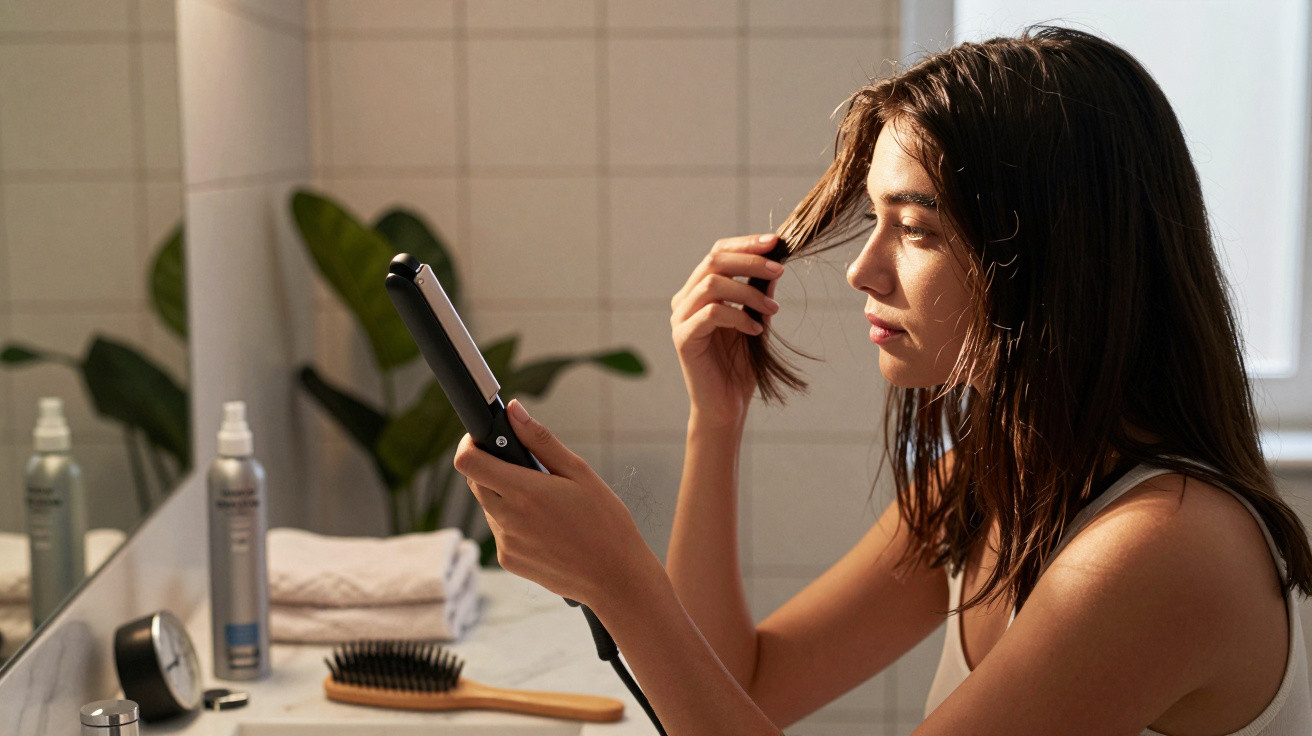
The hairdryer is already on its “Turbo” setting while the straighteners glow red in the bathroom like a warning light. Hair tutorials are playing on TikTok on repeat, and the mental countdown is running: you need to leave the house in 20 minutes. So you quickly run them through once more – just to be sure. Your ends crackle, yet your hair looks wonderfully sleek, so you push that small doubt to the back of your mind. We all know that moment when styling suddenly seems more important than common sense. Then, eventually, comes the shock when you look in the mirror.
The unspoken bargain: straight hair at any cost
Straight hair is often seen as low-maintenance, well-behaved and uncomplicated. That is exactly why many women with naturally fairly straight hair underestimate how much they actually put their lengths through each day. A quick pass with the straighteners, a touch-up on the ends, a fast fix on day two – before long, occasional styling has turned into a routine involving heat almost every day. It does not feel dangerous because nothing hurts straight away.
The industry sells us a bargain: heat equals control. Anti-frizz promises, “Glass Hair” trends and before-and-after videos all feed into it. Meanwhile, almost silently and imperceptibly, the hair pays the price.
You often only notice it in hindsight. Take Jana, 28, whose hair naturally falls straight. A year ago, she began by straightening “just briefly” the front sections every day. Eventually it became the lengths, then the roots, then the ends – in the morning and, “just to be safe”, before heading to a club. At first, her hair looked increasingly perfect in photos. After a few months, though, it appeared duller, her ends started splitting, and her roots became greasy more quickly because she reached for richer products more often. Jana initially suspected “hormonal problems” or poor haircare. The real culprit was constant 200-degree heat on fine, already straight hair.
Studies into heat-related hair damage reveal clear patterns: temperatures from around 150–160 degrees can already alter the hair’s internal structure, causing water to evaporate within the hair shaft and creating micro-cracks. This is often only visibly apparent weeks or months later, when the lengths suddenly feel straw-like and even expensive masks merely disguise the damage instead of repairing it. People with naturally straight hair tend to notice this gradual decline less, because the basic look still appears “tidy”. That is what makes the cycle so deceptive: the drier the hair becomes, the more straightener use is needed to “calm it down”.
How much heat straight hair really needs – and how little that usually is
A more realistic approach starts with one simple question: do the straighteners genuinely need to be switched on today? For many women with straight hair, a more mindful use of a hairdryer and brush, alongside targeted heat protection, is enough to stop this constant overkill. Those with fine or normal, naturally fairly straight hair can often manage with 120–160 degrees. It may sound low, but it is more than enough for the hair’s structure. Keep contact time shorter and work on individual sections rather than the entire head. Suddenly, styling becomes fine-tuning rather than a full daily overhaul.
One practical trick is to reduce the straightener temperature gradually, by 10–20 degrees each week, until you find the point where you are still happy with the result. Many people are surprised to discover that even the “Low” setting leaves their hair straight and smooth – just without that ultra-ironed finish that shines on Instagram but is rarely necessary in daily life.
The biggest styling mistakes rarely come from foolishness; they come from stress, habit and the pressure to look perfect. Many women say they feel “unfinished” if the front section does not lie completely flat or if a wave appears halfway down the lengths. This is where the quiet compulsion begins: one more pass, a little more heat, a little straighter. Let us be honest: nobody follows a haircare routine as consistently as advertising suggests. Masks, oils and heat protection with every pass sound ideal, but hardly anyone does it every day.
People with straight hair in particular often believe their texture can tolerate more. In reality, fine, straight hair is sensitive to repeated damage. Straightening too often disrupts its natural fall, dries out the surface and leaves the lengths more prone to split ends. The result often looks “frizzy straight” – visually free of waves, yet lacking that healthy, lively sheen. The inner voice saying, “Just leave it today,” speaks quietly. We simply ignore it too often.
“The worst moment was when my hairdresser said: ‘Your hair is not naturally damaged – you are frying it.’ I almost felt caught out,” says Lisa, 32, who straightened her already straight hair at 210 degrees every morning for years.
Rather than feeling ashamed, it can help to create a small, personal hair routine. Three points that help many women feel more at ease:
- One heat-free day each week, with both hairdryer and straighteners left off
- Set a maximum temperature – and do not spontaneously “turn it up again for a moment”
- Style only the sections that are genuinely visible instead of automatically straightening everything
Those who maintain this framework for a few weeks often notice that their hair looks less dramatic but healthier. There may be less of a “wow factor” on day one, but more substance over time.
What remains once the steam has cleared
When you listen to women who have genuinely changed their styling habits, the same feeling often comes up: a quiet sense of relief. It is not solely about breakage or shine, but also about the internal pressure to make every strand perfect. Straight hair intensifies that expectation because every minor imperfection stands out – or at least feels as though it does. When the straightener temperature comes down, many people find their pulse does too. They allow their reflection to look a little more human again.
Perhaps that is the real point: heat is not the enemy, but neither is it an innocent tool. It is a compromise, a bargain made with time. If your hair is naturally straight, you are in a particularly fortunate position: you do not need to fight your texture, but instead protect it from being overworked. Less is not deprivation here; it is a return to what is already there. And sometimes that one unruly strand is allowed to exist.
The next round begins in the bathroom, in front of the mirror, in everyday life. It starts when you reach for the hairdryer or press the temperature button. Next time you see that red light, perhaps you will briefly remember how quietly damage develops – and how powerful it can feel when, months later, your hair falls softly again. Then one decision on an apparently ordinary morning becomes a small, deeply personal act of self-care. Not a grand resolution. Just one degree less.
| Key point | Detail | Benefit for the reader |
|---|---|---|
| Too much heat on straight hair | Regular temperatures above 160 degrees cause invisible micro-damage | Understands why hair can become “suddenly” dull and brittle |
| Lowering the temperature consciously | Gradual reductions and a focus on individual sections rather than full lengths | Learns how styling results are possible with significantly less heat |
| A new everyday routine | Heat-free days, a clear upper limit and targeted use instead of automatic habits | Gets a practical system that protects hair in the long term |








Comments
No comments yet. Be the first to comment!
Leave a Comment