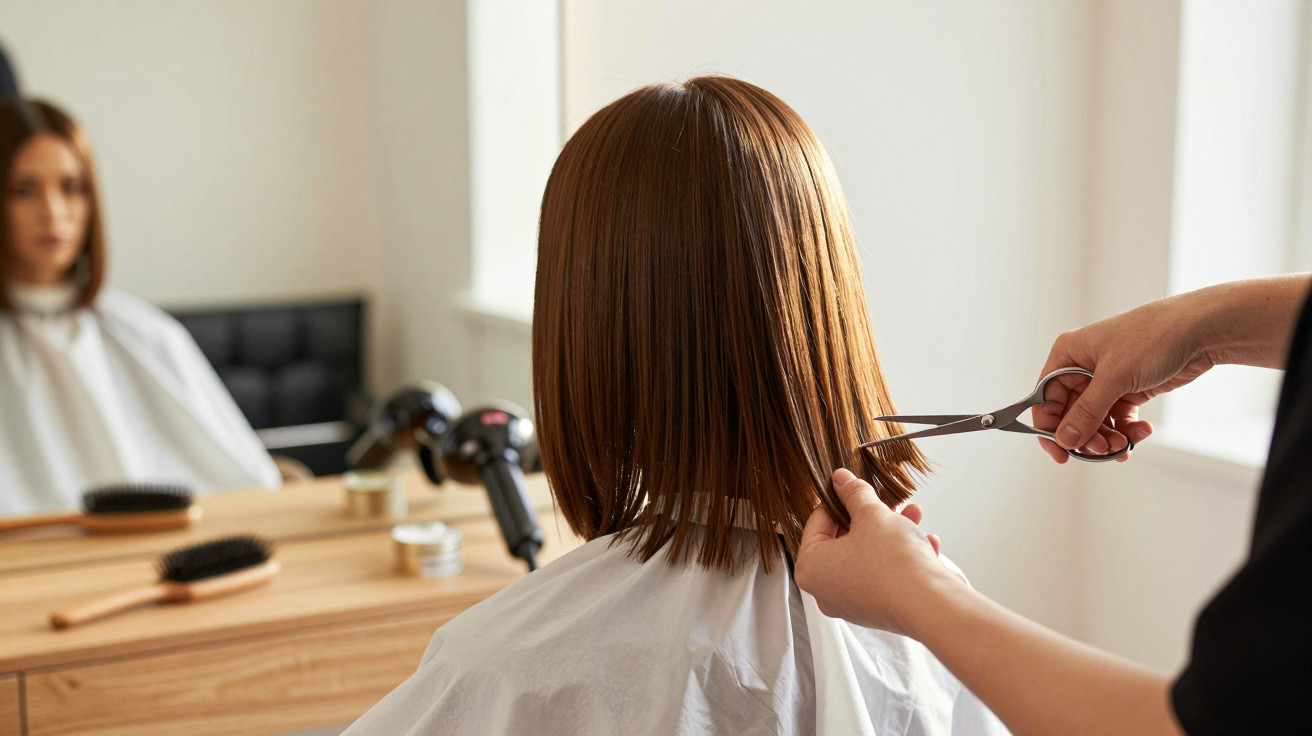
From the front, it may look “fine” – slightly flat, with a few flyaway strands. Yet when the stylist lifts the lengths, light shines through the wispy ends like sunlight through sheer curtains. She frowns. “It just feels…thin.” Her scissors stop mid-air before she proposes something that seems almost too straightforward: a blunt cut. No feathered tips. No elaborate layers. Only one crisp, straight line. Ten minutes later, the very same hair appears twice as full, as though somebody has discreetly turned up the volume. The change can feel almost disconcerting.
Why does cutting hair in a straight line make it appear so much thicker?
Why a blunt cut makes thin hair look instantly fuller
Scroll through any hair-transformation reel and the effect is obvious almost immediately. A client arrives with long, stringy ends drifting around their shoulders. They leave with a neat, weighty line resting at the collarbone, and their hair suddenly seems to have a character of its own.
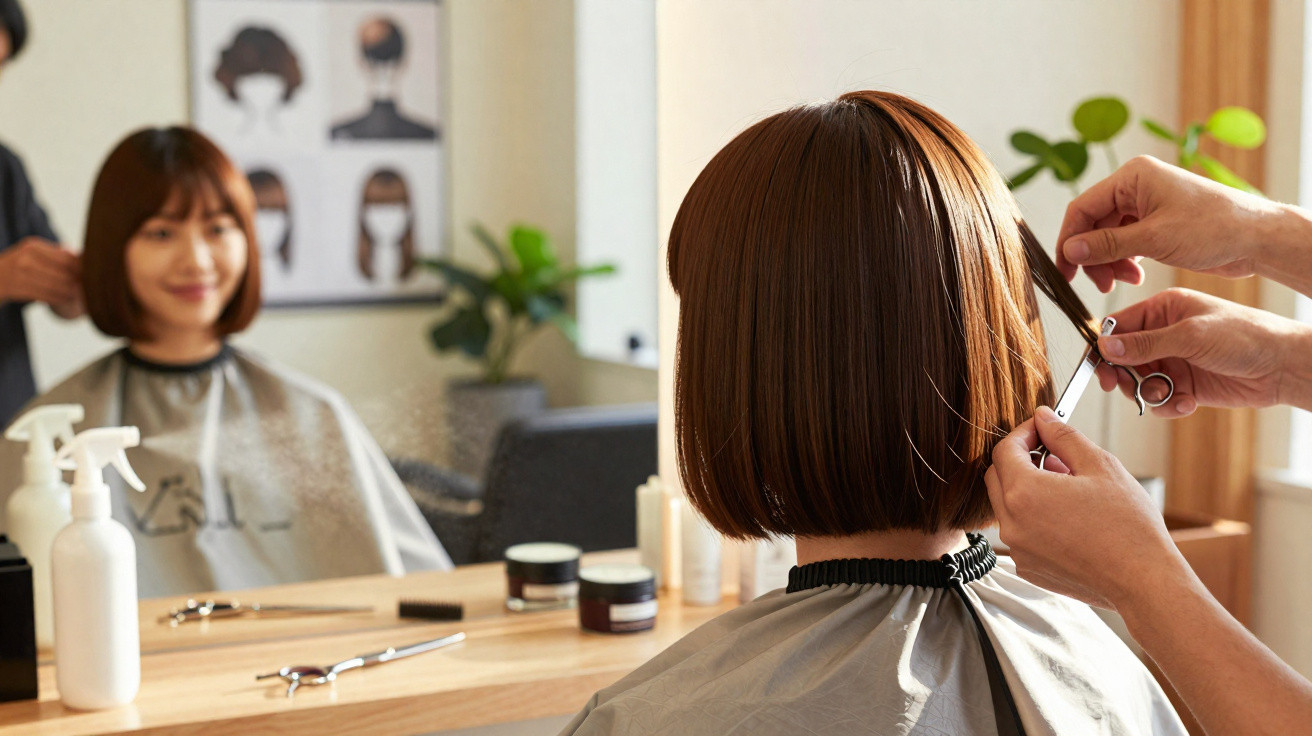
The individual hairs have not changed. Neither has the person wearing them. What has changed is the way the strands collect at the ends. A blunt cut brings them together into one compact edge rather than allowing them to taper away into nothing.
That defined edge is what the eye interprets as “thickness”.
Anyone who has tried to grow their hair “as long as possible” while keeping a feathered, layered finish will often recognise the pattern. The longer it becomes, the finer it appears. The ends begin to look visually frayed. Hair turns in several directions. In photographs, the bottom third can seem to disappear into the background.
Eventually, after watching one more video of glossy bobs and sharply cut lobs, they take the plunge. Their stylist creates a clean line just above the shoulders. The hair drops into place, looking weightier and more deliberate. Friends say, “Your hair looks so thick!” as though something extraordinary has happened in the space of an hour.
There is nothing magical about it. It is simply geometry and the distribution of volume.
Picture hair as a collection of exceptionally fine threads. With wispy or feathered ends, those threads fan out. Light travels through them. The outline appears soft and blurred. Your brain reads that softness as “delicate” or “thin”. In a blunt cut, each thread finishes at almost the same point. This forms a dense perimeter – a noticeable boundary that blocks light and gives the shape definition.
The fuller appearance is not created by having more hair. It comes from focusing the hair you already have into a shorter, stronger outline. Rather than prioritising “length at all costs”, you choose density that is genuinely visible.
How to request – and maintain – a blunt cut for thin hair
For fine hair, the most successful blunt cuts tend to sit in a very particular range: usually from the chin to the collarbone. This length is long enough to feel feminine or polished, while remaining short enough that the ends have not had the chance to become thin and split.
When you are in the salon chair, keep your request clear: “I want a one-length, blunt cut that makes my hair look thicker, not wispy.” Use your fingers to show exactly where you would like the line to fall. If your hair is exceptionally fine, ask the stylist to use as few layers as possible at the bottom. Gentle face-framing is perfectly acceptable. What matters is that the hem – the lower edge – remains substantial.
It is like choosing a straight hem on a dress rather than a frayed one.
The period between appointments is where many people become disappointed. The style looks brilliant for the first six weeks. Then the familiar stringiness starts to return. The ends tangle more easily. That crisp line becomes softer. At shoulder level, the hair begins flipping out unpredictably.
Let’s be honest: nobody truly does this every day. Few people have time for a full “salon blowout” routine each morning, especially when they are already dealing with flat hair. The aim is not perfection, but doing enough maintenance to preserve the result.
Stylists who regularly work with fine hair often quietly advise booking trims every 8–10 weeks for blunt cuts. This is not about maintaining shape in the layered sense; it is simply about stopping that dense edge from fraying again. Waiting three or four months does not preserve length – it merely reduces the density at the bottom.
Fine hair has one unforgiving enemy: invisible thinning.
This happens gradually over several haircuts when thinning shears or razors are used at the ends “to make it lighter”. For thick hair, this can feel liberating. For hair that is already thin, it can make the final five centimetres appear almost transparent.
When you sit in the chair, be direct about what you do not want. Avoid aggressive thinning at the ends. Avoid heavy internal layers that weaken the perimeter. Ask the stylist to assess the line when your hair is dry and straight, rather than only when it has just been styled with bounce and volume.
“For fine hair, I’d rather cut off an extra half-inch than ‘soften’ the ends with a razor,” explains London-based stylist Mia Roberts. “That clean edge is where all the visual density comes from. Once you shred it, you can’t fake fullness with products alone.”
There is an emotional element to giving up length, too. On a difficult day, it is easy to hold on to those final wispy inches as evidence that your hair can be “long”. On a better day, you catch sight of yourself with a newly cut blunt lob and question why you delayed it for so long. On an excellent day, someone casually asks, “Did your hair grow? It looks thicker,” and you understand the illusion your mirror is creating.
- If your hair is very fine: Choose a bob or lob with virtually no layers through the lengths.
- If your hair is fine but wavy: Retain the blunt edge, while allowing your stylist to add the gentlest internal shaping to prevent it from becoming too rounded.
- If your hair is thin because of breakage: Cut back to the point where the ends feel solid between your fingers, even if it initially feels shorter than you would like.
Living with a blunt cut: what changes and what stays the same
A blunt cut will not transform naturally fine hair into a lion’s mane. Each strand remains the same diameter, and root density stays unchanged. However, your day-to-day experience of your hair can alter in small but unexpectedly emotional ways.
Brushing can suddenly be faster because the ends are no longer knotting around one another. Ponytails may look narrower yet sturdier, rather than sad and straggly. Blow-drying takes less time, but the finished effect still appears intentional rather than accidental. On camera – during video calls, in selfies, or in unplanned back-camera photos taken by friends – your hair’s outline finally stands out against your clothes and surroundings.
More deeply, a blunt cut can quietly change how you feel about “length at any price”. On a packed commute or beneath unforgiving office bathroom lighting, wispy ends tend to highlight every fragile centimetre. A sharp, solid edge does the reverse: it frames the face and directs the eye to where you want it to stop.
Some people find that they play with their hair less. There is simply more to grasp at the bottom, so the habit of rolling delicate ends between finger and thumb starts to fade. Styling becomes a matter of subtle adjustments – a bend with straighteners, a little texturising spray, or a quick smoothing pass with a brush – instead of complicated methods designed to hide transparency.
We have all seen our hair reflected in a shop window and wondered, “Is it really that thin?” A blunt cut will not eliminate that thought forever, but it changes what is visible. Instead of watching your hair vanish as it falls, you see it arrive cleanly at an intentional line.
Hairdressers often speak about “shape” and “movement”. For fine hair, a blunt cut delivers something more straightforward and grounding: presence. Your hair takes its place in the frame of your life rather than quietly retreating from it. It can remain soft, feminine and playful. It simply stops apologising at the ends.
Perhaps that is why so many people who choose a blunt cut for thin hair seldom return to feathered, see-through styles. It is not because blunt cuts are fashionable. It is because, once you have seen your own hair look that solid and healthy, those fragile, wispy inches no longer have the same appeal.
| Key point | Detail | Benefit for the reader |
|---|---|---|
| Blunt cut vs. wispy ends | Brings strands together into a dense perimeter instead of allowing them to fade away | Helps explain why hair can look thicker after just one haircut |
| Length “sweet spot” | Chin to collarbone, with minimal layers for fine hair | Helps you decide where to cut for visible fullness without losing your sense of self |
| Maintenance habits | Regular trims and avoiding excessive thinning or razoring at the ends | Explains how to maintain a thick, healthy appearance rather than watching it fade |











Comments
No comments yet. Be the first to comment!
Leave a Comment