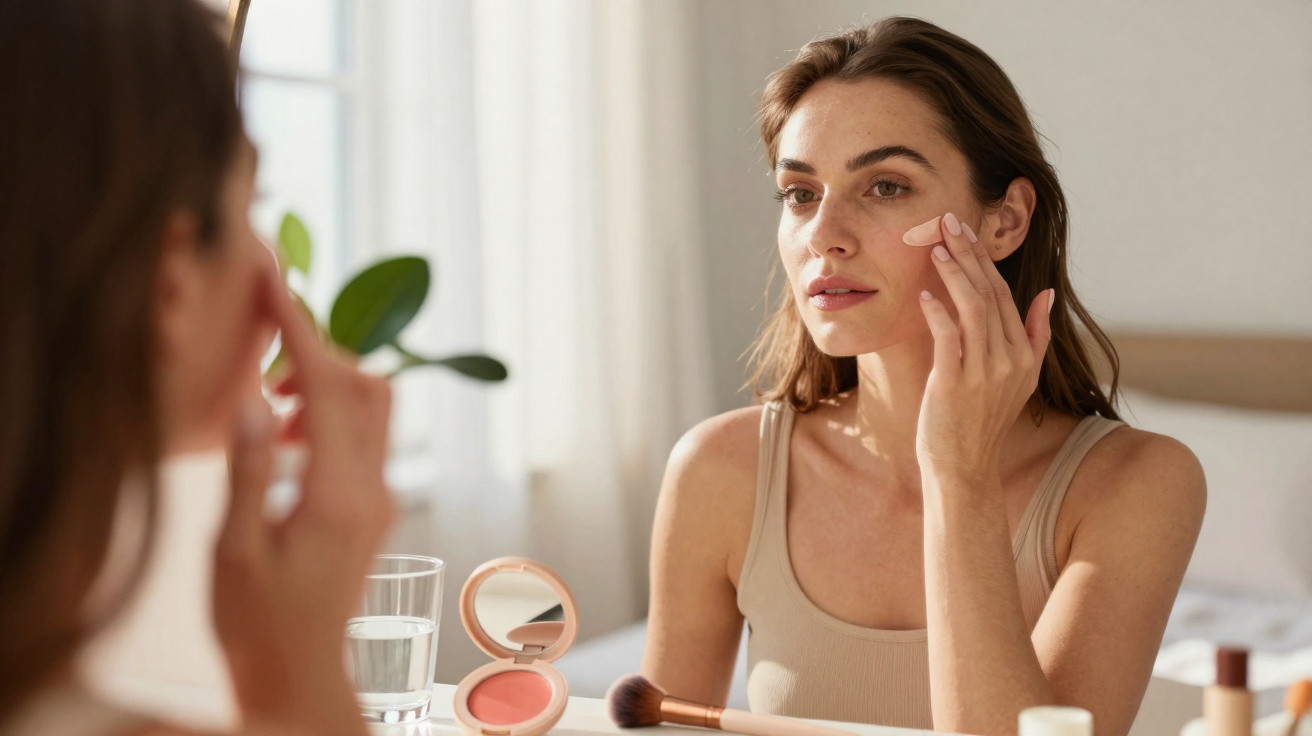
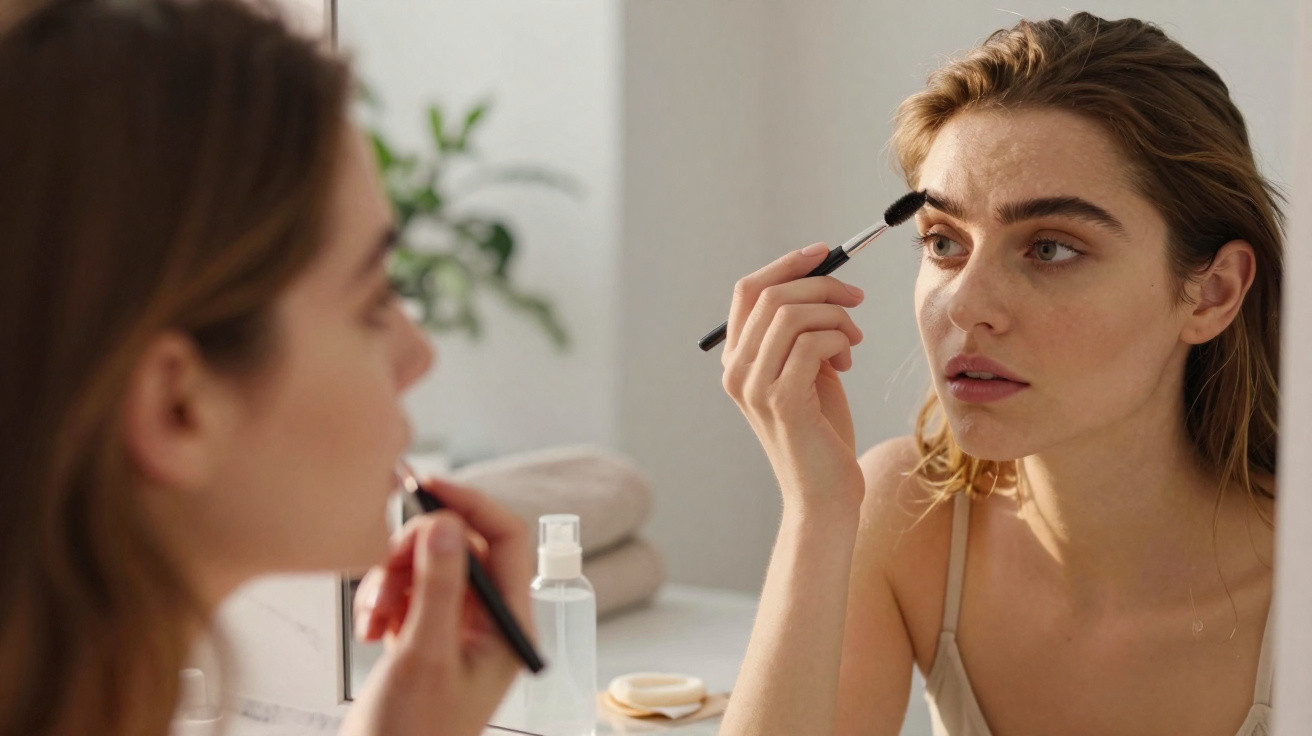
The woman reflected in the bathroom mirror looks much as she did at 25, but not quite.
Her cheeks rest slightly lower now; the rounded apples that once lifted when she smiled blend more gently into her jawline. She picks up her trusted blush brush, makes the familiar neat ‘smile and dab’ motion over the apples of her cheeks … then stops.
Rather than creating a lifted radiance, the colour appears to pull her features downwards. The shadows beneath her eyes seem deeper and the middle of her face looks a little puffy. She removes it, begins again and places the blush a fraction higher. Instantly, her cheekbones seem more defined, her face brighter and her eyes more alert.
The blush is unchanged. So is the woman. Yet her face looks entirely different.
It was not the product that changed; it was the placement guide she had been using.
When blush no longer works as it once did
There is an odd stage of life when a makeup routine starts to resist you without warning. There is no dramatic dividing line, only the gradual thought, ‘Why does this not look right any more?’ as you repeat techniques that worked perfectly for years.
Blush is frequently the first thing to cause trouble. Worn low and in a rounded shape, it can unexpectedly make a 32-year-old appear worn out by 4 p.m. Colour that once looked fresh on the apples of the cheeks can settle near soft nasolabial folds and fine lines. Rather than shaping the face, it gathers there.
At that point, a small adjustment to blush placement begins to matter more than the blush formula itself.
A London makeup artist told me that she can often estimate a client’s age from one detail: the instinctive way they apply blush. Younger people tend to press it directly into the centre of the cheek, almost as though copying a child’s drawing. Those over 30 often stick to the same habit, even after gravity has subtly altered the canvas.
She described two sisters, aged 28 and 38, who visited together. They had the same palette, lighting and skin tone. A bright touch of colour on the apples lifted the younger sister’s entire look. On the older sister, however, identical placement unexpectedly drew attention to mild hollowness beneath her eyes.
Once the artist moved the 38-year-old’s blush upwards and nearer her temples, she looked as though she had enjoyed ten hours of sleep. The colour worked like a soft-focus filter, directing attention towards her eyes and cheekbones rather than the centre of her face.
The reasoning is straightforward, even if it is rarely discussed. After 30, the bone structure remains, but the fat pads above it begin to redistribute. The cheek ‘apple’ shifts downwards. Meanwhile, muscle memory still prompts you to smile and apply colour where that apple used to sit. As a result, colour lands in the very part of the face that is beginning to descend.
Applying blush there creates a visual downward pull. Moving it slightly higher and further out creates the opposite effect. Your real facial features do not change; you are simply altering where another person’s eye is drawn first.
That is the true impact of one small sweep of pink.
The simple blush map that lifts the face
The technique currently circulating among makeup artists is almost remarkably simple. Rather than smiling and placing colour on the apples, keep your face relaxed and look directly ahead. Next, picture a diagonal running from the top of your ear to the side of your nostril.
Apply blush over the upper half of that line, positioning it closer to the ear than the nose. Aim for a soft, slanted ‘C’ shape that curves towards the outer corner of the eye. Blend upwards towards the temples instead of down into the centre of the cheek. The colour should become more diffuse as it reaches the hairline, resembling a watercolour wash.
For most faces over 30, this immediately reveals cheekbones you may have forgotten were there.
One further small change can have a major effect: leave a clear space between the under-eye area and the point where your blush starts. Keeping roughly a finger-width of bare skin prevents colour from catching in fine lines or highlighting dark circles. If you enjoy a youthful, flushed finish, add the tiniest hint of blush across the bridge of the nose, but keep the strongest colour high and towards the outer face.
Many people over 30 describe the same dilemma: they want radiance but worry about ending up with clown cheeks. That concern is understandable. One overly heavy, low swipe can make it look as though last night’s wine is still visible in your face.
For this reason, placement matters more than the quantity of product. Begin with far less blush than you expect to need. Pat rather than sweep. Build colour through light, translucent layers instead of applying one dense stripe. Cream blushes can be more forgiving on changing skin texture because they melt into the complexion rather than sitting on its surface.
Let’s be honest: no one truly does this every day with a professional brush and 20 minutes at the mirror. You may be applying it one-handed while replying to a message with the other. Choose one rule that you can recall on a busy Tuesday - such as ‘higher and further back’ - and forget the rest.
Your face will forgive plenty. What it will not forgive is blush in the wrong postcode.
One makeup educator I spoke to expressed it plainly:
“After 30, your blush either lifts your face or drags it down. There’s not much in between.”
It may sound dramatic, but side-by-side photographs of different blush placements make her point clear.
There is an emotional aspect, too. On a day when your energy is low, placing that sweep slightly higher can feel as if someone has gently increased the brightness of your whole expression. You suddenly look like the version of yourself you still feel like inside.
- Think in angles, not circles: sweep blush upwards on a diagonal rather than applying a rounded patch.
- Keep the strongest colour away from the nose and mouth.
- Blend towards the temples to create a visual lift on the outer face.
- Opt for cream or liquid formulas if powder settles into texture.
- Reassess your blush map every few years; faces change, and routines should change with them.
When blush becomes a quiet rebellion against the mirror
There is something subtly radical about altering the way you use a product you have applied for 15 years. It means gently acknowledging that your face has changed, then choosing to work with it rather than against it. A single understated diagonal sweep becomes a small negotiation with time.
Friends discuss ‘looking tired’ or ‘not quite like myself’ in bathrooms. Often, it is not that their face has changed so drastically, but that light and shadow now travel across it differently. Alter the placement of colour and you change where the light appears to fall. It is almost philosophical: the map you draw on your skin changes the story your face tells before you say a word.
We have all caught our reflection in a shop window and thought, Who is that? Repositioning blush does not remove that jolt. It can, however, soften it. The right placement quietly says, You’re still in there. It does not claim that you are 22. Instead, it brings out the structure, experience and expression you have gained, without making everything appear to sink.
This modest adjustment is oddly easy to share. After trying the higher, lifted placement and seeing the contrast, it is difficult not to demonstrate it to a friend, sister or mum. You end up using the half-and-half method: one cheek in the old style and one in the new. Usually, that contrast communicates more than any tutorial could.
Blush becomes less about following trends and more about learning your own facial architecture. Where does your face respond best to colour? Where does it immediately look more awake and less weighed down? No single diagram works for every person, but one principle offers guidance: colour that travels upwards usually suggests youthfulness and energy. Colour that collects in the centre more often suggests fatigue.
Perhaps that is why this method repeatedly returns to social feeds, regardless of how contouring and highlighting trends rise and fall. It is straightforward, requires little effort and does not call for a haul of new products. You are simply moving something you already own a few millimetres upwards.
And across that tiny distance, something in your reflection shifts quietly as well.
| Key point | Detail | Benefit for the reader |
|---|---|---|
| Place blush higher | Apply it along the upper part of the ear-to-nose line, towards the temples | Creates a visual lifting effect without a procedure or filter |
| Leave space below the eyes | Keep a finger-width of bare skin between dark circles and blush | Reduces emphasis on dark circles and fine lines |
| Favour an angle over the ‘apple’ | Create a soft diagonal shape rather than a circle on the cheek | Defines features and avoids a ‘drooping cheeks’ effect after 30 |






Comments
No comments yet. Be the first to comment!
Leave a Comment