On the Underground, a young woman wrestles with her hood in the reflection. Beneath it, a tangled mass of brown curls peeks out: partly brushed straight, partly abandoned. She runs her fingers anxiously through her hair, flattening some strands and pulling others tightly back. You can see her doing the mental calculation: do I look “tidy”, or already “too wild”? Beside her, another woman flicks through photographs on her phone. Her hair is straightened in almost every picture; only one shows its natural curls. She swiftly swipes past it. These small, quiet gestures play out across entire cities, in offices, classrooms and at family gatherings. Curls are hidden, restrained, tamed and ironed out. The question is: what are they hiding from?
The invisible norm: why straight hair is still seen as the “standard”
Anyone who looks properly around an office or lecture theatre, or scrolls through Instagram, will notice it immediately: most hairstyles are straight, perhaps with a slight wave. Curls appear like a “special effect”, rather than something ordinary. We all know the moment when someone arrives at work with freshly straightened hair and everyone suddenly says: “Wow, you look so professional!” The compliment is well meant, but its subtext is clear: your natural curls seem less serious. Over the years, these quiet messages build up in the mind like layers of hairspray.
Lena, a 32-year-old journalist, has 3A curls that immediately turn into a frizzy halo in humid conditions. At school, people called her “Poodle”; at job interviews, she was told she had a “youthful look”. At 19, she therefore bought her first hair straighteners. “Since then, I’ve straightened my hair before every important appointment,” she says. When she covered court cases as a reporter, she would get up especially early for hearings. A Yale University study found that test subjects were more likely to rate women with straight hair as “competent” and “reliable” than women with tightly curled or Afro-textured hair. Findings like this make their way into lifestyle magazines and career guides, before eventually becoming a gut feeling shared by millions of women.
This goes far beyond a styling trend. In many Western cultures, straight hair is regarded as “neutral”, almost invisible. It does not stand out, does not cause disruption and simply “fits”. Curls, by contrast, are quickly labelled “noticeable”, “chaotic” or “too much”. Advertising, film and fashion have shaped this framework over decades: the successful businesswoman wears her hair straight, while the untamed rebel has curls. Let’s be honest: hardly anyone consciously thinks “curls are unprofessional”, yet those associations quietly activate in the background. Every woman with curls senses that underlying judgement long before anyone puts it into words.
Control, hair-care frustration and small acts of rebellion: what really lies behind hair straighteners
One reason so many women conceal their curls is both mundane and unforgiving: time. More time in the bathroom, more products and more failed attempts. Curls have a life of their own, responding to the weather, water hardness and even a pillowcase. Many women say they do not decide how their hair will look – the climate does. Straightening offers a sense of control. You roughly know what will greet you in the mirror. You know how your hairstyle will look after a four-hour meeting. And you do not have to deal with remarks such as “Didn’t you use a comb today?” In a tightly scheduled daily routine, reaching for hair straighteners is often less about vanity than self-protection.
Take Mareike, for example: 26, training to become a teacher, with type 2C/3B hair – strong, dense curls. At university, she often wore her hair loose and natural. “The children will pull your hair, you’ll see,” an older colleague told her during a placement. So she began tying it tightly into a bun. Later, straightening creams became part of the routine, “to make it look tidier”. Once, she wore her curls loose during her teacher training, and a pupil asked whether she was “going to a party today”. Small comments like these linger, particularly in professions where you are watched, assessed and expected to be a “role model” all the time. In such settings, straight hair can feel like a camouflage cloak, while curls resemble a bright sign.
Then there is the sheer overwhelm. People who grew up with curly hair have often heard lines such as “Just brush it properly” or “Use more mousse”. Many mothers with straight hair simply did not know how to care for curls, and passed that lack of knowledge on. The result was snagging brushes, drying shampoos and heat-damaged ends. At some point, a belief takes hold: my hair is “difficult”. Straightening then seems like a solution, a quick “fix”. Yet the cost is high: breakage, dry lengths and a styling compulsion that feels like an invisible dress code. And in the background, one private question remains: what would my curls look like if I truly got to know them?
Returning to curls: practical steps without the pressure to be perfect
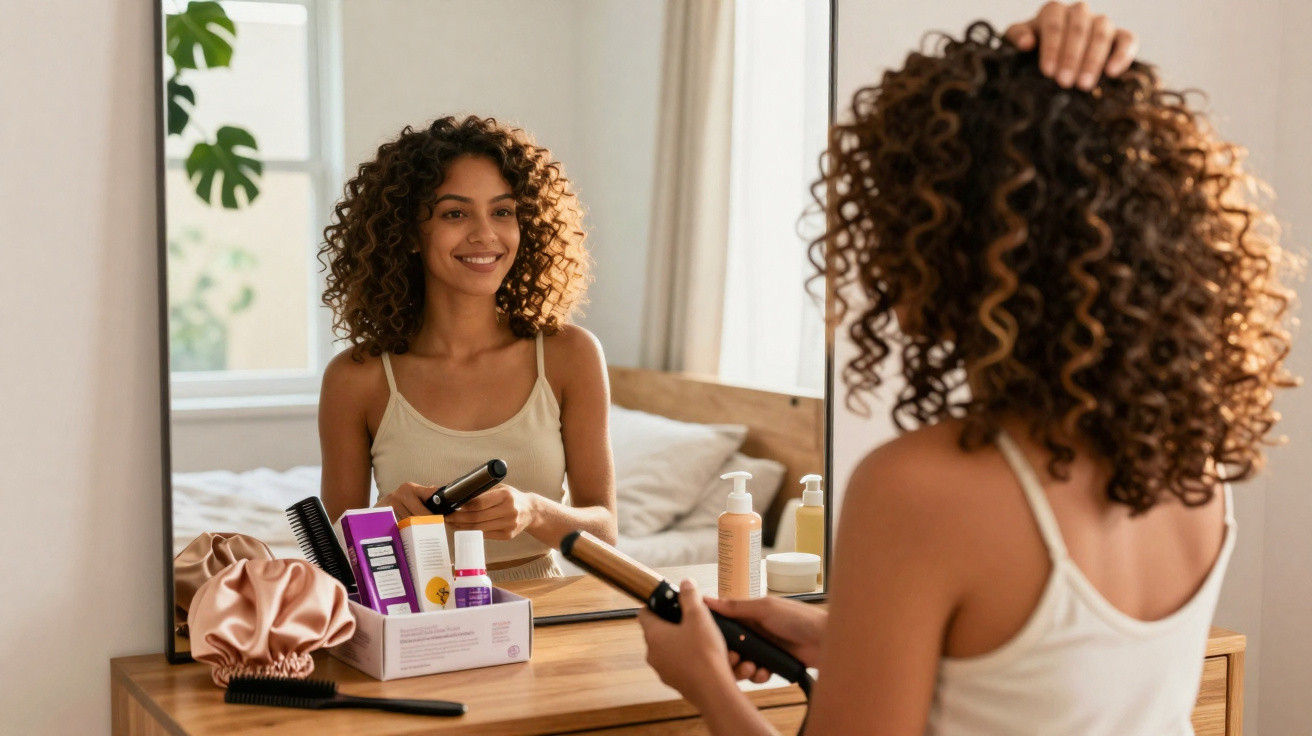
Anyone who no longer wants to hide their natural texture does not have to change everything overnight. A realistic first move is often to straighten less frequently: once a week rather than every day, and later only for special occasions. At the same time, it is worth taking an honest look at the products in the bathroom: replace sulphate shampoo with a mild, curl-friendly alternative, try a rich conditioner and perhaps add a leave-in product. One small experiment a week is enough to gradually reconnect with your own hair. It then feels less like a radical break and more like a gradual return.
The second point matters almost more than any product: the image in your mind. Many women expect their “natural curls” to immediately resemble the carefully styled Pinterest photographs after months of straightening. They do not. Hair needs time to recover and regain its bounce. You also need time to become accustomed to seeing your real reflection. One tip often shared by curly girls is to use transitional hairstyles: perhaps a high “pineapple” ponytail, a half-bun or a bandana to cover the more “unpredictable” sections. This allows curls to return to everyday life bit by bit, without making you feel completely exposed to every glance.
“It was as though I was seeing myself without a filter for the first time – unfamiliar, but somehow more honest,” says Nina, 29, who is slowly bringing back her natural waves after straightening her hair every day for 10 years.
- A gentle shampoo check: Swap products one at a time instead of changing everything at once.
- A phased break from heat: Reduce blow-dryer heat, lengthen the gaps between straightening days and genuinely use heat protection.
- Find realistic role models: Follow people with a similar hair texture, not only influencers with “perfect” curls.
- Build a support circle: Bring friends, partners and colleagues on board, and openly say that you want to rediscover your natural hair.
- Celebrate small wins: Record a day when your curls look lovely instead of focusing only on “bad hair days”.
Shame, pride and the question of who our hair is meant to please
When women hide their curls, it is rarely just about styling. It is about belonging, role models and power. In many cultures, particularly dense curls or Afro-textured hair carry a political dimension. Hair straighteners and chemical relaxers are then more than beauty tools; they become symbols of conformity. At the same time, it is far too simplistic to label every woman with straight hair as “conforming”. Some simply feel more comfortable that way, while others enjoy changing their look. The more revealing question lies beneath it: who decides what counts as “well-groomed”, “serious” or “beautiful”?
It is striking how quickly such norms can change. Television series, advertising campaigns and catwalks are featuring more and more people with visible, un-ironed curls. Children’s books show little heroines with Afros, ringlets and tight curls. At the same time, old comments persist stubbornly, often through ignorance. There is the colleague who asks whether you are “ill” because you are wearing your hair “like that” today. Or the aunt who advises you to “do it properly for once” for a wedding and books you a straightening appointment. Real women, real lives and real insecurities exist between these two poles.
Perhaps the most honest answer to why so many women hide their natural texture lies somewhere between convenience, conditioning and fear of rejection. That is also where an opportunity exists. Anyone who has experienced the freedom of leaving the house on a rainy day without fighting every wave understands how much energy has previously gone into “hair control”. The remaining question is uncomfortably clear: do I style my hair this way because I genuinely like it, or because I have learned that it is the only way I count as “right”?
| Key point | Detail | Benefit for the reader |
|---|---|---|
| Social norms | Straight hair is often viewed as “neutral” and professional, while curls are seen as “noticeable” | Better understand personal insecurities and recognise external pressure |
| Hair care and time | Curls are considered “complicated”, leading to frustration, a hair-straightener routine and hair stress | Understand why straightening feels appealing and develop more realistic expectations of curly-hair care |
| A gentle route back to natural texture | Gradually reduce heat, use suitable products, adjust mentally and seek support | Practical, achievable steps for embracing your own hair texture – without pressure to be perfect |








Comments
No comments yet. Be the first to comment!
Leave a Comment