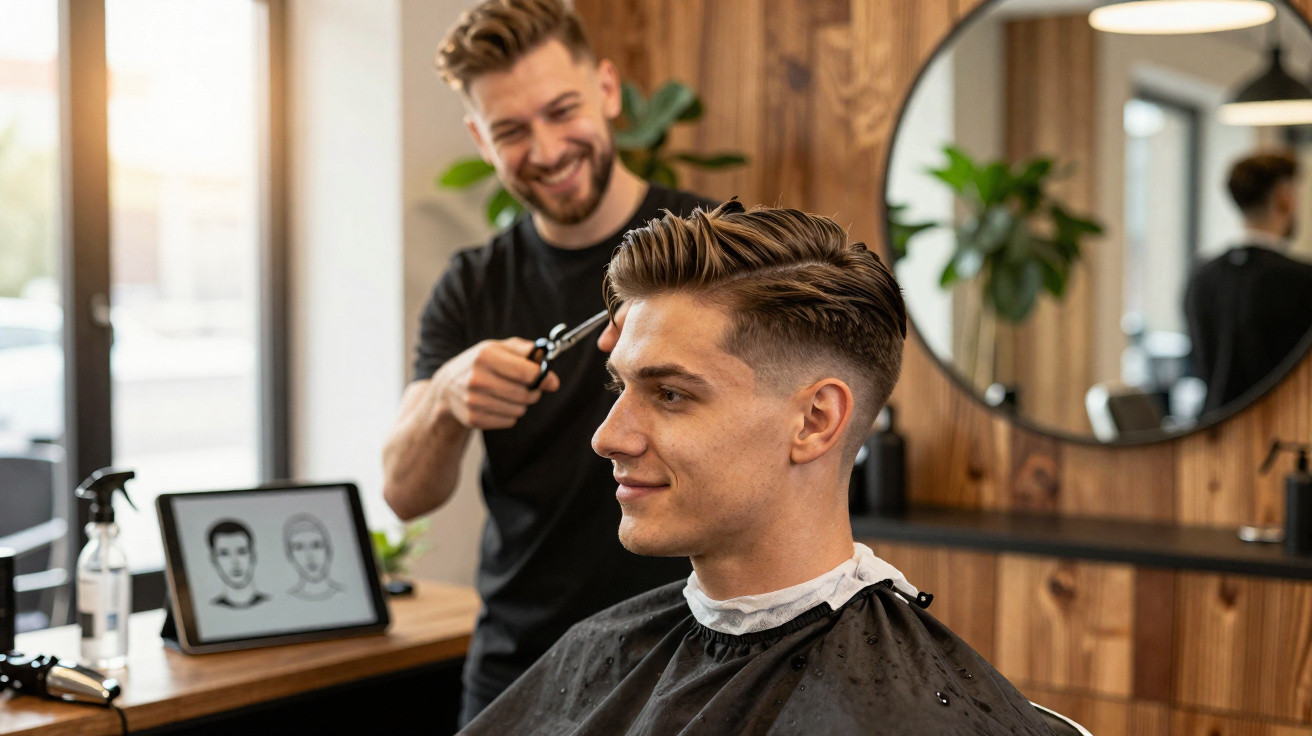
The man seated ahead of me in the barbershop looked self-assured when he arrived. Smart trainers, a crisp shirt, and the sort of jawline plenty of men would swap a month of gym sessions for. But when the barber turned him towards the mirror after the cut, his expression sank.
The fade was precise, the edges immaculate, and the barber had plainly delivered a competent cut. Yet something still felt wrong. His head now seemed longer, his forehead looked enormous, and his cheeks appeared hollow, as though he had shed weight in 20 minutes.
He narrowed his eyes, tipped his head and attempted an uneasy smile. The question was obvious in his face: “Why doesn’t this look right on me?”
That is the understated disappointment behind many men’s haircuts.
Why so many men choose a haircut that works against their face
Walk along any crowded high street and pay attention to the men you pass. The same three or four styles appear repeatedly on completely different face shapes: high fades on rounded, soft faces; thick fringes on men who already have short foreheads; and ultra-short sides on narrow temples that only look narrower afterwards.
At a quick glance, most do not look “bad”. The fade is newly done, the styling cream is in place, and the barber has given them exactly what they requested. The issue is the unspoken clash between the cut and their bone structure. A haircut can improve your face, or subtly undermine it every day.
I once spoke to an office worker who repeatedly said, “Every haircut makes me look fatter.” His face was naturally round, with prominent cheeks and little definition around the jaw. For years, he had taken TikTok screenshots of close skin fades and short crops on top to the barbers. These are the sorts of cuts that look strikingly sharp on lean men with angular features.
On him, however, the style made his head look like a perfect circle. There was no height, only width. His cheeks stood out more, while his jaw seemed to recede. He assumed the problem was the barber and moved from one salon to the next, never recognising that the cut itself was drawing attention to every insecurity he had about his face.
Most men do not study their own features; they follow trends. They see what suits celebrities, the muscular man in their social feed or the confident colleague at work. Then they enter the barbershop and use those doomed words: “Just like this, bro.”
Haircuts are about geometry and visual illusion. Top length, side volume, the point where the fade begins and where the fringe finishes all alter the apparent width, height and proportions of your face. Without knowing your own face shape, you are effectively taking a gamble with your appearance every four weeks. And the house nearly always wins.
How to read your face before sitting in the barber’s chair
The first understated skill men need is not styling or product knowledge. It is the ability to view their face as an impartial stranger would: no filters, no mental alterations, just its actual shape.
Stand before a mirror, sweep your hair back and assess the frame of your face: forehead, cheekbones, jaw and chin. Is it longer than it is wide, or wider than it is long? Is your jaw straight and angular, or gentle and rounded? Does your forehead command attention, or do your cheeks dominate? That is your true starting point, rather than your favourite footballer’s haircut.
Most men never carry out this brief assessment. They decide they have a “fat face”, a “big forehead” or a “weak chin”, then leave the matter there. They do not consider what is genuinely true about their overall outline.
Consider the man with a long, narrow face who insists on keeping long hair at the sides “for coverage”. The more hair he adds there, the taller and thinner his face can appear. Or take the man with a very short, square face who prefers strong buzz cuts. Whenever he cuts everything down, his head becomes a compact box.
To be honest, nobody needs to do this every day. But doing it once may save ten years of unsuitable haircuts.
The principle of matching a cut to your face shape is straightforward: your hair should counterbalance what your bone structure naturally does. A long face will probably benefit from less height and slightly more controlled width at the sides. A particularly round face may suit a little additional height on top with restrained sides, rather than bulky volume that broadens the whole silhouette.
The wrong haircut magnifies what already concerns you; the right one discreetly brings everything into balance. A blunt fringe can reduce the appearance of a long forehead, but it may also make an otherwise balanced face look squat. Very short sides can create definition around a soft jaw, but they can make naturally hollow cheeks look tired and gaunt. This is not about rigid rules; it is about working with, rather than against, your own structure.
How to speak to your barber without leaving disappointed
One simple, practical change can transform the experience: stop requesting haircuts and start describing results. Rather than saying, “Give me a high fade and short crop”, say, “My face looks round in photos, I’d like more structure and a bit of height, not too much width.”
That gives your barber a clear purpose. They can tailor the fade height, the side weight and the length on top to suit your skull and face. Ask where your face is widest and narrowest, and what they would adjust to create balance. A capable barber can spot this within seconds, but most men never ask.
Pride is one of the things that affects men most while they are in the chair. They worry about admitting, “I don’t know what suits me, can you help?” So they put on an act instead. They mention haircut names they only partly understand or present a random screenshot, then try to appear relaxed as the cape comes off and their stomach drops a few inches.
There is also a tendency to simply agree when the barber turns the chair around. You do not have to love the result immediately. You can calmly say, “The sides feel a bit too tight for my face” or “I think I need a little more length on top to balance my forehead.” That is not being demanding. It is taking part in decisions about your own face.
Sometimes the bravest thing a man can say in a barbershop is, “What do you think suits my face shape?” It sounds simple, but it opens a real conversation instead of a transaction.
- Ask for balance rather than a trend
Explain how you would like your face to appear: longer, sharper, softer or more defined. This is more valuable than naming a haircut. - Treat photos as guidance, not a rule
Show your barber what appeals to you, then ask, “How would you adapt this to my face?” You are not copying a style; you are translating it. - Look at the outline, not only the fade
When you are given the mirror, examine your silhouette from the side. Does your head seem taller, wider or smaller? Does that improve or detract from your features? - Book a “learning” cut once
Arrange a slightly longer appointment and tell the barber that you want to understand your face. Ask questions. That one cut can inform every appointment that follows. - Accept your natural shape
You cannot cut your way into a different skull. You can only choose the version of yourself that looks most deliberate and alive.
When your haircut suits your face shape at last
A subtle change occurs when a man finds the cut that genuinely belongs with his face. He no longer keeps fixing his fringe in bathroom mirrors. He stops analysing every angle in selfies. His reflection begins to look steady, authentic and grounded.
You do not suddenly turn into someone else. You simply stop battling your own geometry. The forehead you disliked becomes a natural focal point. The jaw you believed was weak appears sharper because the sides no longer overwhelm it. The cheeks that made you self-conscious look structured, rather than puffy or hollow.
That is the real explanation behind seemingly mysterious “glow ups”. Often, it is not the gym or clothing that comes first. At some point, someone looked at their own face with curiosity instead of frustration and selected a cut that works in their favour.
Once you understand this, you notice it everywhere: the man whose long hair pulls his face down when a shorter, lighter style would lift it; the man concealing himself beneath a cap because every haircut he has had has opposed his shape; and the rare few whose hair simply looks right even when it is slightly overgrown. They were not merely fortunate. Somewhere along the way, someone took their bone structure seriously.
If you have felt quietly disappointed after nearly every visit to the barbers, the issue may not be you, your barber or even your hair. It may simply be that nobody taught you to ask one very straightforward question: “What does my face actually look like, and what kind of haircut respects that?”
Once you ask it honestly, without ego, you do not really return to the old approach.
| Key point | Detail | Value for the reader |
|---|---|---|
| Understand your face shape | Examine your forehead, cheekbones, jaw and overall outline before selecting a cut | Reduces trial-and-error haircuts that draw attention to insecurities |
| Communicate effects, not trends | Describe how you want your face to appear rather than only naming the haircut | Allows the barber to adapt styles to your real features |
| Use your barber as an ally | Seek their view, make adjustments during the appointment and use one session as a “learning” cut | Helps create a long-term look that suits you instead of pursuing random photos |















Comments
No comments yet. Be the first to comment!
Leave a Comment