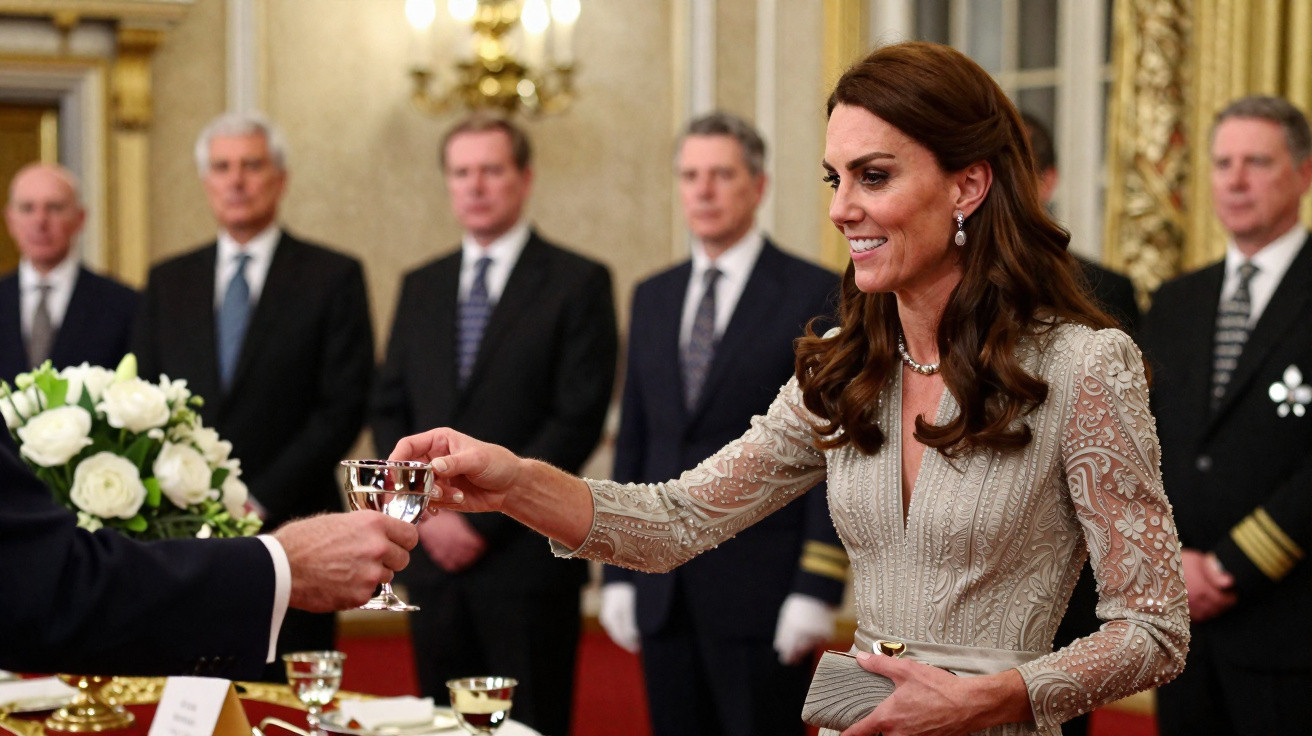
The flashbulbs go off before anything else. White bursts of light bounce from gleaming crystal and silver serving domes as the state-banquet doors open, sending anticipation across the hall. Conversations fall quiet. It feels as though the cameras are holding their breath for the single image that will circle the globe by morning. Then she arrives: Kate Middleton, the Princess of Wales, entering in a lace-embroidered gown that looks almost otherworldly beneath the chandeliers. It is the sort of dress that appears to glide rather than walk. There is the well-known poise, the recognisable half-smile and, beside her - or, more accurately, above her - the accessory for which everyone has been waiting. The tiara, now her unspoken signature accessory, shines like a headline already prepared.
At that point, something changes. This is no longer merely a dinner; it becomes a worldwide moment clothed in lace.
When one dress takes over a diplomatic evening
From the other side of the banquet room, there is little that looks overtly political. A stream of black dinner jackets, dark uniforms and gowns in rich jewel tones fills the space - until one bright sweep of white lace cuts through it. Kate’s gown is not showy or loud; its impact lies in its restrained details. Floral embroidery rises across transparent sleeves, while the close-fitting bodice recalls historic couture and the skirt moves with a gentle, unhurried flow. Protocol requires phones to remain face down on the tables, yet everyone is already mentally drafting their captions. This is the picture destined to eclipse the speeches: lace, tiara and the composed confidence capable of outshining a room of world leaders without a word.
The narrative seems to take shape in front of us. Near the entrance, a photographer inclines forwards as the Princess pauses just long enough for the lace to catch the light. At table seven, a foreign minister gives a colleague a nudge, not to discuss policy but to say, “Look at that dress.” Away from the official lenses, palace staff already know what is coming: it will be trending before midnight. Most of us recognise the moment when one outfit entirely takes over the conversation; here, it happens on a scale of millions. Before dessert arrives, social-media feeds from London to Seoul are filled with the same image - Kate, the lace gown and the unmistakable tiara - while the evening’s actual agenda quietly takes second place.
There is a reason this occurs whenever she attends a state banquet. Royal fashion is more than clothing: it also operates as soft power. Kate’s lace-embroidered gown communicates tradition and delicacy without suggesting weakness. Lace brings with it centuries of skilled craftsmanship, turning diplomacy into elegance. Combined with her signature accessory - the tiara she wears time and again - the look is rooted in continuity. It communicates that this is not an arbitrary choice of outfit, but another part of an unfolding visual narrative. The gown acknowledges artisans; the tiara evokes history. Together, they dominate the room because those present understand, at some level, that they are seeing an image likely to endure beyond the evening.
The coded language of lace, jewels and repetition
Such apparently effortless command is carefully planned. Kate’s team does not simply select an attractive dress from a rail on the morning of a banquet; they construct a story. First, they select a shape already linked with her image: a defined waist, flowing skirt and sculpted shoulders. Next, they add lace embroidery that remains striking both at close range and from 30 metres away under stark flash photography. Finally, they bring out the signature accessory that has become visual shorthand for “Kate at her most official self” - a tiara worn at consecutive state occasions and recognisable even in a small thumbnail. It is a deliberate approach built on repetition: repeating a visual signal until it becomes iconic.
Anyone who has faced a wardrobe before an important event and felt overwhelmed may find the principle unexpectedly familiar. The emotion is the same; only the scale differs. Kate relies on a formula many of us use without admitting it: identify a silhouette that suits you, then alter the details. The lace pattern may vary between banquets - floral one year and more geometric the next - yet its emotional message remains consistent: romantic, assured and slightly unattainable. The tiara anchors the entire effect. It is the royal version of the jewellery piece worn automatically at every major milestone. In truth, few people do this every day, but when an occasion matters, familiar habits tend to beat experimentation.
Beneath the glitter, the real process is communication wrapped in tulle and diamonds. The palace knows global audiences no longer wait for formal statements; they scroll, pause over an image and interpret a room through a dress. In selecting lace - a material connected with patience, artisanal expertise and femininity - Kate embraces a gentler form of power that fits her public image. Repeatedly choosing her go-to tiara creates reassurance and recognition. That is why headlines the following morning focus less on diplomatic wording than on fashion analysis. In a room where others negotiate through language, she negotiates through fabric. And the world is clearly paying attention.
What this viral royal moment reveals about us
When watching the excitement surrounding Kate’s lace gown and sparkling heirloom, it is easy to dismiss it with, “It’s just a dress.” But the global response reveals something fundamental about our attachment to visible narratives. We live at a time when geopolitics can feel burdensome, abstract and draining. A state banquet filled with extended toasts about trade deals is not easy to process emotionally. A woman crossing a chandelier-lit room in a remarkable gown is. It is easily understood, captured on screen and strangely reassuring. So we enlarge the embroidery, discuss the tiara’s history and exchange views on sleeves and necklines, while the true purpose of the dinner continues quietly in the background.
There is nothing embarrassing about that reaction. People have always used clothing to interpret status, emotion and intent. Royal style simply magnifies this instinct. Perhaps that is why photographs of Kate in the lace-embroidered gown can feel almost intimate, even to those nowhere near the palace. They connect with personal memories: the outfit we agonised over before a wedding, the shoes we wished we had not chosen or the accessory that made us feel ourselves on a night when we had to make an impression. The distinction is that an entire team and centuries of protocol rest on her look, whereas most of us are battling a mirror and unflattering lighting.
“Fashion at this level is less about vanity and more about reliability,” a former royal dresser once confided. “People need to know what they’ll feel when they see her walk into a room.”
- Lace and classic silhouettes are used to communicate continuity.
- A familiar tiara is worn again to ensure immediate recognition.
- Dramatic experiments are avoided on major diplomatic evenings in favour of subtle development.
- Photographs are allowed to carry the public-relations message in countries where few people will hear the speeches.
- The team accepts that one gown can - and will - overshadow policy, and plans accordingly from the outset.
Beyond the tiara: what remains after the cameras leave
After the final flash has disappeared and the red carpet has been rolled away, what lasts is not only the recollection of a lace-embroidered gown moving through a room of world leaders. It is also the quiet recognition that an old ceremony has adapted to a new world. State banquets are no longer sealed-off, mysterious occasions; they are content. The Princess of Wales arriving in her favourite tiara is not simply a royal appearance, but a carefully designed connection between a very small room and a vast, restless audience scrolling on buses, sofas and late at night in bed. Some people will dismiss the fascination. Others will zoom in and save screenshots for inspiration, or merely to feel a little closer to that immaculate, distant world. Either way, the intended message has been received.
Not everyone possesses a palace wardrobe or inherited diamonds, yet the principle is surprisingly adaptable. Return to the things that genuinely feel like you. Pick details that communicate the story you want to tell. Accept that people will interpret your appearance whether or not you mean them to. Kate’s banquet gown is an ideal example, not because most of us will ever wear couture lace beneath state-banquet chandeliers, but because the tension she navigates each time - being observed, assessed and still arriving in something that feels authentic - is uncomfortably familiar. That may be why these images remain with us. We are not only seeing a princess in an exquisite dress; we are seeing a woman aware that the entire world is watching, who enters the room regardless.
| Key point | Detail | Value for the reader |
|---|---|---|
| Visual strategy | Repeating a lace silhouette and a recognisable tiara at major events | Demonstrates how consistency can create a personal “signature look” in everyday life |
| Symbolic message | Lace as a reference to craftsmanship, tradition and restrained softness | Helps explain the unspoken language behind high-profile outfits |
| Media impact | Kate’s appearance overshadows policy discussion, taking over headlines and social feeds | Shows how images influence what we remember about major public events |
FAQ:
- Question 1 Why did Kate Middleton’s lace-embroidered gown create such a reaction at the state banquet? Because it paired a familiar and flattering silhouette with detailed lacework and an instantly recognisable tiara, producing an image that was immediately suited to screens and emotionally satisfying for global audiences.
- Question 2 Was lace chosen purely for fashion? No. Lace has long-standing links with luxury, craftsmanship and traditional femininity, fitting Kate’s position as a royal figure who is both modern and classic.
- Question 3 What does her “signature accessory” mean in this context? It describes the tiara she has repeatedly worn for significant state occasions, which has become visual shorthand for her most formal and high-stakes appearances.
- Question 4 Do these fashion decisions genuinely influence diplomacy? Not in direct policy terms, but they affect public perception, make formal occasions seem less distant and help humanise state events for people who encounter them only in photographs.
- Question 5 Is there a lesson for people outside royal life? Yes: repeating several key features - such as a silhouette, type of fabric or accessory - can establish a recognisable personal style and convey a consistent message, even on a far smaller everyday scale.













Comments
No comments yet. Be the first to comment!
Leave a Comment